

The Texas Silver Haired Legislators (TSHL) will return to The Texas State Capitol to the opening of their 21st Biennial Session of 2025-2027, with two Southeast Texas representatives joining in the quest for state support for senior citizen issues.
TSHL, as it is organized, strives to promote good government for all Texans by directly involving senior citizens in the legislative process, according to the group’s stated mission. TSHL provides a nonpartisan forum for discussion and debate of senior issues, advocacy training, and an avenue through which older citizens may serve as a resource to both public and private sectors.
Since the first Silver-Haired Legislature was organized by the State of Missouri in 1973, the concept has been adopted in 26 states. The Texas branch was introduced to the Board of Directors by the Advisory Council of the Texas Department on Aging in 1983, where it was listed as a “legislative priority.” A resolution to establish the TSHL was passed by the Board in 1984. In 1985, the 69th Texas Legislature adopted Senate Concurrent Resolution #37.
Legislators representing the 28 Silver-Legislature Districts (SLD) from all over Texas will begin arriving May 17 at the Wyndham Garden Hotel. Two TSHL Legislators from Southeast Texas, Ira Wilsker and Ida Duplechin, will be participating in Austin, and presenting four resolutions that they authored, which will be debated on the floor of the Texas House.
The ceremonial opening of the 21st TSHL Session will take place on Monday, May 18, at 9 a.m. in the House Chambers, with TSHL speaker Dr. Sherry Hubbard presiding. The session for the week will adjourn on Thursday, May 21.
An anticipated 64 resolutions will be debated in the chamber of the House of Representatives at the Texas State Capitol, according to TSHL reps. Adopted resolutions will be included in the biennial TSHL Legislative Report required to be delivered to the governor, the Texas Legislature, and directors of the 28 Texas Area Agencies on Aging districts in advance of the 90th Session of the Texas Legislature.
TSHL speaker Sherry Hubbard said the resolutions for this session were first written by the organization in July of 2025. The process begins by members researching matters that are important to them that can be passed through the Texas legislature to improve the lives of senior citizens throughout the state.
The proposed resolutions are broken down into eight different Legislative Issue Committees (LICs), which include Criminal Justice, Health & Human Resources, Human Services, PIIFS (Pensions, Investments, Insurance, & Financial Services), Retirement & Aging, Rural – Urban, State Affairs and Utilities & Natural Resources. The resolutions, which were as high as 91 originally, were then narrowed down, with some being combined, Hubbard added.
The resolutions are brought to the legislative session, where the voting process begins to determine which will pass into future bills from the Texas Legislature; TSHL only decides on the resolutions, not the actual bill itself.
After the legislative session, the TSHL then decides what elements to include in their annual legislative report, which is processed by August, then printed to be brought to the capitol by October. Additionally, TSHL members will vote on which 20 resolutions, out of all the ones that pass, to prioritize.
TSHL’s recent touted legislative successes include:
- Silver Alert for missing seniors
- ERS pension funding for financial soundness
- TRS pension funding for financial soundness
- Additional state funding for the TRS-CARE (Teacher Retirement System of Texas)
- Increased medical cannabis authorization
- Authorizations for Tele-Medicine and Tele-Dentistry
- Expansion of the Rural Broadband program (which brings connectivity to homes that do not have access to affordable high-speed internet)
- Criminal penalties for Senior Financial Abuse, including actions of “Undue Influence”
- Streamlining physician licensure requirements for APRNs (Advanced Practice Registered Nurses)
- Reporting of communicable diseases in certain LTC facilities
- Continued line item funding for Senior Corps
A total of 297 bills have been created in the last 41 years since the TSHL has been in existence, Hubbard said. During that time, the 297 bills have either been codified into law and/or fully funded.
“We've done great work over these 41 years,” Hubbard said. “I just don't believe that we (have put the) message out as well as we should have, because too many people have never heard us.”
TSHL is authorized to have 123 legislators, with the amount in each county varying depending on the city’s size. However, they only have 78 members.
“It's so frustrating, we've had 15 new legislators sworn in since January. But, on the same note, we've had 11 resignations, either because of their own health, their spouses' poor health, or some other (issue)...like (needing to go) back to work full time because they needed the money to survive…so they didn't feel they could do justice to being a TSHL member or legislator and not come to our sessions,” she said, adding that this is especially the case because the TSHL is a nonprofit and is self-funded. Because of this, everyone living further away will have to pay for their own transportation and accommodations for each legislative session.
Due to costs, TSHL has its own foundation and fundraisers to provide funds for people who cannot otherwise afford the expenses required. Other resources come from grants for special projects and individual members. TSHL also has a gala fundraiser every biennium.
TSHL member and representative from the Southeast Texas Council of Governments, Ira Wilsker, said senior citizens issues are important to him, as he has seen firsthand how senior citizens suffer, especially when it comes to crime-related matters.
“I’ve trained youth officers, magistrates, JPs and judges on the chain of command in dealing with the crimes of the elderly,” Wilsker said. “I taught in the police academy and the sheriff's academy here for 29 years. We've had (sessions for treating) emotionally disturbed people, domestic violence…LGBTQ…, but there has been near zero training on dealing with crimes against seniors.”
Southeast Texas governing law treats crimes against seniors (defined as individuals 65 or older) with severe penalties, often elevating offenses to higher felony categories due to the victim's vulnerability. However, the definition of “senior citizen” for other matters is 60 and older.
“There's no consistency of aging,” Wilsker pointed out. “Why should someone who is 60, 61, 62, or 64 ,who's a victim of violence or fraud or other crime, not (get the same rights) until they're 65 (but get them at) 60 for other things? The statutes are inconsistent.”
Additionally, the way senior citizens have been treated in senior homes has been a significant matter, Wilsker said, as he shared an experience of one TSHL member taken to a residential facility after a major surgery – and how dilapidated its conditions were.
“(There were) no nutrition standards, but Adult Protective Services came in. They made (the care home staff) throw away most of the food they had,” he said. “It was outdated, and no one cared. There was one young lady in her 20s, who basically lived there 24/7, and a dementia pensioner, in her 80s…nobody ever took her to the bathroom. She was filthy; she hadn't had a shower or a bath in months…nobody was taking care of her.”
In response, Wilsker wrote down several resolutions to tackle the situation. One was to improve upon the 2-1-1 system for Southeast Texas. 2-1-1 is a nationwide number that can be reached 24/7 where senior citizens can discuss their issues over the phone, “with a real person,” he emphasized, and be provided with resources. The second was to provide informative papers to senior citizens of their rights in large font, which makes it easier for them to read. Additionally, he wrote one resolution to extend the mandated minimum level of care in Assisted Living Facilities (ALFs) and senior care homes.
Overall, Wilsker said he’s enjoyed his part in TSHL.
“It's a ball. It keeps me up and active,” he said.
The TSHL is currently seeking applicants. Those interested in applying must be 60 years or older prior to filing for election, a resident of the SLD election district to file as a candidate from that district and a registered voter of the state of Texas.
For more information on applications, visit https://tshl.org/join-texas-silver-haired-legislature/.
For more about the TSHL, visit https://tshl.org.
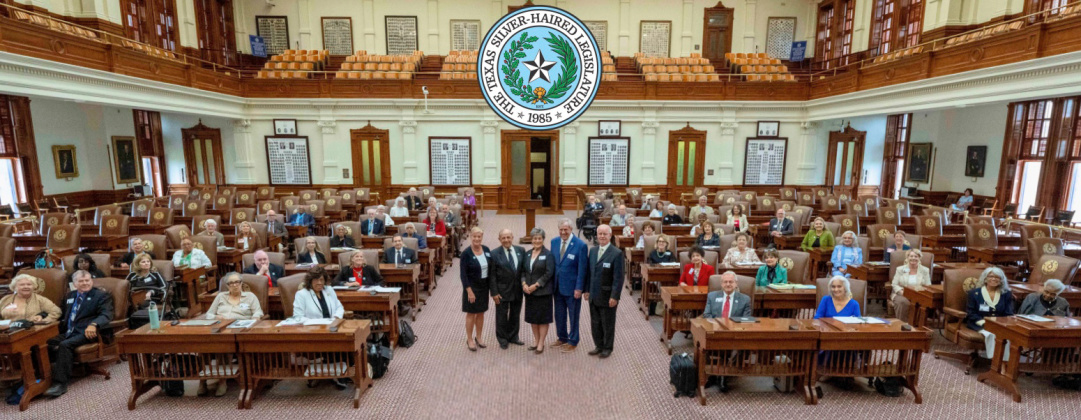
Members of the Texas Silver-Haired Legislature, courtesy image.