

The Alamo commemorated the 190th anniversary of The Battle of The Alamo on March 6 of this year, and many of its descendants attended the event. However, one such Southeast Texas descendent learned just how much his family history and close friends are tied together.
Josh Crawford, a descendant of Almaron Dickinson, said the revelation occurred at the ceremony. Crawford was talking with someone about his ancestry, when he found out Alamo soldier George C. Kimble was, like Dickenson, from Pennsylvania; the duo was even friends and business partners before joining the battle.
From there, Crawford found out that Southeast Texas friends Leigh Kimball and her late husband Russell “Russ” are related to George C. Kimble on the father’s side.
“It's like finding a needle in a haystack…to know somebody that's that close, that lives in your own community, that you've known for a long time, and to have that distant connection without even realizing it, Crawford shared with The Examiner. “The world's a big place, but it's also small (in a way). That was a neat thing to find out.”
Crawford said his father and grandmother were an active part in the historical community, with his father being a member of the Sons of the Republic of Texas and his grandmother being a member of the Daughters of the Republic of Texas, but the 190th anniversary event for the Battle of the Alamo was his first time attending an event for the Descendants at the Alamo. Crawford said it was “eye-opening.”
“There were so many different groups,” he said. “They had us in the Alamo at night, and they would actually call out family members' names. It was interesting.”
Crawford said that, growing up, he always knew of his family heritage. But, it wasn’t until later that he started researching the history behind it.
Almaron Dickinson (1800 – March 6, 1836) was a Texian soldier and fought during the Battle of the Alamo and the Texas Revolution. He was best known as the artillery officer of the small garrison at the Alamo battle, according to historical sources.
Dickinson was born in Pennsylvania, most likely in the city of Philadelphia, according to Crawford. Two years after he married Susanna, he moved to the Mexican province of Texas in the Dewitt Colony. This is around the time when he started a blacksmith shop and partnered with Kimble in a hat factory.
During the Texas Revolution, Dickinson served as a defender during the Battle of Gonzales in the fall of 1835 and was elected as the First Lieutenant of Artillery that December. He joined the group planning to defend San Antonio and became an aide to General Edward Burleson during the Siege of Bexar. Dickinson rose to Lieutenant in the Texian Army. Feb. 23, 1836, Dickinson moved his family inside the Alamo.
By this time, Dickinson was in command of the Alamo’s 21 cannons. Lieutenant Colonel Willaim Barrett Travis led a force of 180-250 men, which included Dickinson. And, after Santa Anna arrived with his forces, the siege began; it through the morning of Feb. 25, 1836, but the Mexican soldiers were able to cross the San Antonio River and took shelter in abandoned shacks. Travis called for volunteers to burn the shelters, which is where Dickinson and his men planned to provide cover by firing an eight pound cannon filled with grapeshot and canister.
Dickinson lived until the last day of the Battle of The Alamo. According Susanna’s account, Dickinson hid his wife and daughter inside the chapel. Near the end of the battle, he ran inside, telling them that the Mexicans were inside the Alamo’s walls. He then returned to his post and is believed to be one of the last defenders killed in action.
George C. Kimble (March 6, 1803-March 6, 1836) was also from Pennsylvania, according to historical sources. In 1825, he moved to Texas as a member of the Green DeWitt Colony where he met Prudence Nash. The two married and moved to Gonzales, Texas. Around this time, Kimble and Dickinson met and started a hat factory.
When the famous “Victory or Death” letter made its way to Kimble, he told his family of his departure, remarking that he may not return. Feb. 23, 1836, Kimble was placed into the Gonzales Ranging Company as a lieutenant and commander. After learning that military officer James Fannin would not be present, Kimble and another soldier named Albert Martin led the unit to the Alamo.
As they approached, a nearby rider asked them if they wished to go into the fort, which they affirmed. The unit went to follow the rider, but one of the men in the unit grew suspicious of the rider’s true nature, which caused him to flee. Afraid of potentially being discovered, the unit quickly continued toward the fort and, in the darkness, some of the Texians thought the unit was a group of Mexican soldiers and fired. One man was wounded, and his spoken English was convincing enough to let the unit inside.
This group of soldiers, along with Kimble, would be known as the "Immortal 32,” or the only unit to answer to the call for troops. Kimble also died during the Battle of the Alamo and was burned with the other soldiers.
“It’s the beginning of Texas history and to be a part of it is pretty amazing,” Crawford said.
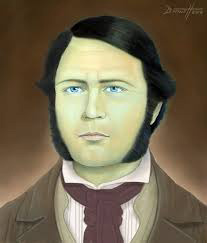
A portrait of Almaron Dickinson, courtesy image.
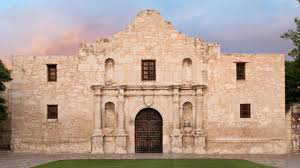
The Alamo monument, courtesy image.