

Trapped between illness and justice
As April, widely recognized as Mental Health Awareness Month, draws to a close, Southeast Texas finds itself at a crossroads. In Beaumont, construction crews are putting the finishing touches on a $70 million expansion aimed at transforming access to mental health care right on College Street. The promise is visible, tangible, and long overdue.
Yet, inside the walls of the Jefferson County Correctional Facility, a different reality persists — one where some of the most vulnerable individuals, those struggling with severe mental illness, remain trapped in a system not designed to heal them.
At the center of this contradiction is the case of Dr. John Walter Bordages, a clinical psychologist whose ongoing legal battle has become a stark example of how the judicial system can falter when mental health and criminal justice collide.
The conversation around mental health in Southeast Texas has grown louder in recent years, fueled in part by advocates like Elizabeth McIngvale, Ph.D., Director of the OCD Institute of Texas. Speaking at the April 9 Mental Health America of Southeast Texas luncheon titled “In every story, there is strength,” McIngvale offered a deeply personal perspective. She described growing up with the financial means and family support necessary to seek treatment for obsessive compulsive disorder, admittedly a privilege many do not have. Even then, intervention required decisive action.
“Mental illness looks like me…it looks like you…it doesn’t matter what you have or where you come from,” McIngvale shared.
Her words underscore a critical truth professionals have long maintained: mental illness does not discriminate. It can affect anyone, from a child in a well-resourced family to a professional with advanced degrees and a respected career.
In Southeast Texas, it also looks like a man, who is both from a well-resourced family and holds an advanced degree, sitting in jail, waiting. Bordages is not an anonymous defendant lost in the system. He is a trained clinical psychologist, a man once entrusted with evaluating others’ mental states. Today, he finds himself on the other side of that evaluation.
Bordages is charged with the state jail felony of criminal mischief stemming from an incident on June 25, 2023. That night, Bordages was captured on a neighbor’s security camera shattering the glass of a custom front door belonging to Carl Peyton, who also serves as president of the homeowners association involved in an ongoing dispute with Bordages.
The damage, valued at over $2,500, elevated the offense to a felony.
Bordages confessed to police that night, but the incident did not occur in isolation. According to the Peytons, the behavior continued and included harassment, additional property damage, and escalating concerns that something far more serious than a neighborhood dispute was unfolding.
As Bordages’ case moved through the court of Jefferson County Criminal District Court Judge John Stevens, troubling patterns emerged. During multiple court appearances, Bordages made statements that raised red flags about his mental health. He claimed someone was logging into his computers and erasing forensic reports, his hard drive had been stolen, his identity and credit cards had been compromised. These claims, whether grounded in reality or not, when paired with odd correspondence with the court, signaled symptoms that demanded attention.
Bordages’ attorney, John D. West, acknowledged as much. In July 2024, West appeared in court without his client.
“He’s on bond and we haven’t seen him yet,” West told the court, and also referenced what he described as a “memorable letter” Bordages had sent to the court in place of appearing in person.
Judge Stevens’ reaction was immediate.
“Good Lord,” Stevens uttered while skimming the correspondence.
Along with the letter, Bordages submitted a disc the court ultimately decided not to upload to its systems.
The situation had moved beyond routine criminal proceedings and entered the realm of competency.
By October 2024, a motion to suggest mental incompetency had been filed. The court ordered Bordages to undergo evaluation by Dr. Ed Gripon, but even that process was fraught with complications. Bordages reported attempting to be evaluated and being turned away. Gripon later suggested that Bordages may not have properly communicated the nature of the court-ordered evaluation when he called his office, and noted that he does not typically see patients from the general public.
Months passed and evaluations were lagging. Finally, in February 2025, Bordages was declared incompetent to stand trial. The court determined Bordages required involuntary psychiatric treatment to restore competency. Rather than this treatment becoming a turning point and catalyst for progression through the legal system, instead, Bordages’ case became a revolving door of more than two dozen resets and delays.
September 29, 2025, Bordages was remanded to custody for violating the terms of his bond by harassing his neighbors, as well as the GPS monitoring company. He has remained in custody since.
March 3, Bordages’ case was reset on the announcement docket to allow the state to assist in locating the person with Power of Attorney for payment of restitution. More than a month later, on April 10, the case was reset once again on the announcement docket with the state claiming continued efforts to locate his Power of Attorney.
Bordages’ case is currently on the May 11 morning announcement docket.
Somewhere along the way, an unofficial agreement was mentioned that would allow Bordages’ release from custody once restitution on the matter was paid in full. At the heart of the delay is money, or more specifically, access to it. Sources indicate Bordages granted Power of Attorney to longtime friend John Riess, giving him control over financial matters. The court stated it believes Bordages has sufficient funds to pay restitution to the Peytons, yet the matter has not been settled.
Riess, however, paints a different picture. Riess told The Examiner he was told by West to mail a check for restitution.
“Yes, he has the money for it… (but) I don’t have checks. I live four hours away, and (Bordages) accused me of stealing his money, so I don’t want to do any of this,” said Riess.
Despite state prosecutors at the Jefferson County District Attorney’s Office being assigned to assist in locating Riess for the restitution payment March 3, and reporting to that court that they are still trying to locate Riess as of April 10, the Power of Attorney told this newspaper that he hasn’t heard from anyone with the DA’s office.
“Nobody’s reached out to me,” Reiss said. “They know where I am; they have my phone number.”
Despite being a key figure in resolving the case, Riess said he has never spoken with state’s attorney, Kyle Gasper.
The breakdown in communication has effectively left Bordages stuck — legally, financially, and physically. Complicating matters further are concerns about Bordages’ legal representation.
Bordages told Jefferson County Sheriff Zena Stephens that his attorney, John D. West, has not visited him since his return to custody Sept. 23, 2025.
“That’s very common with the public defenders,” Stephens said. Visitor records confirmed by JCSO Chief Deputy John Shauberger support Bordages claim that, in fact, his attorney had not been to visit him during the seven months he has been in custody.
In an effort to locate West through the State Bar of Texas, since his office recently relocated and does not currently have a working business telephone number, it was discovered that West had two recent public sanctions on his record with the State Bar of Texas – both for failing to keep clients reasonably informed about the status of their cases and for failure to comply with reasonable requests for information. The first offense in December 2020 resulted in public reprimand, while the second resulted West being suspended from the practice of law for a period of one year, and placed on probated suspension June 1, 2024, through May 31, 2025.
West told The Examiner that, before his client was found incompetent, Bordages was in his office numerous times.
“I’ve not been to see him since he’s been found incompetent (Feb. 12, 2025), but that is because he isn’t even able to make decisions,” West told The Examiner. “Eventually they have to let him go. He owes some restitution and I’m told he has plenty of money in the bank … He’s getting close to having to be released based on time served alone.”
West said he did reach his client’s Power of Attorney by phone once, but Riess refuses to speak with him now and all efforts to locate or communicate with Riess are going through the DA’s office now.
A sentence without conviction
For a state jail felony conviction in Texas, the sentence ranges from six months to two years.
“He would have been out by now, but the two years will be up pretty soon and I will file for his release if we get to that point,” said West.
In other words, Bordages, without being convicted of a crime, may soon reach the maximum time he could have served if he had been convicted.
Sheriff Stephens acknowledges the imbalance.
“Legally, they’re only allowed to stay in jail no longer than their sentence would be if they were found guilty, and he’s getting pretty close,” she said.
Despite this, Stephens said Bordages remains in general population, reportedly functioning well and causing no issues. The sheriff’s concern for Bordages and many others like him is that functioning is not the same as healing.
Stephens told The Examiner that she has spent years watching cases like this unfold — and worsen.
“The jail is a place for punishment – some of these guys need a place for healing,” she said.
Across the country, jails have become default mental health institutions — not by design, but by necessity. Without sufficient community resources, law enforcement often has few alternatives.
In Jefferson County, the stark reality has had consequences.
“We’ve had people in our jail three or four years waiting on competency hearings,” Stephens said. “And, what we are seeing is the regression of people’s mental capacity when they sit there in jail – not getting better, getting worse.”
The Jefferson County Diversion Center, currently under construction off FM 3514, represents a shift in philosophy, but help won’t come soon enough for Bordages. “Pass the buck” delays that have controlled Bordages’ case will result, without intervention, in the former physician serving a complete jail sentence before an alternative facility is available.
Once the diversion center is operational, instead of arresting individuals in crisis, officers will soon have the option to bring them to a facility designed for care — not confinement.
There, trained professionals will assess mental health needs, provide medication, connect individuals to long-term resources and, perhaps, most importantly: they won’t be under arrest.
The case of Dr. John Bordages is not just a timeline of a legal story. It is a human one.
It is about a man who once helped others navigate mental illness, now unable to navigate his own path through a system that requires clarity, communication, and competence — precisely the faculties his condition may impair.
It is also about a neighbor seeking justice, a friend who has reached his limits of being able to help, and a sheriff witnessing systemic failure firsthand.
As Beaumont prepares to open new doors to mental health care, the question remains: What happens to those already trapped in the old system?
McIngvale’s words echo:
“Mental illness looks like me…it looks like you…”
In this case, it looks like Dr. John Bordages — sitting in a jail cell, waiting for a system to decide whether it will punish him, treat him, or simply run out the clock.
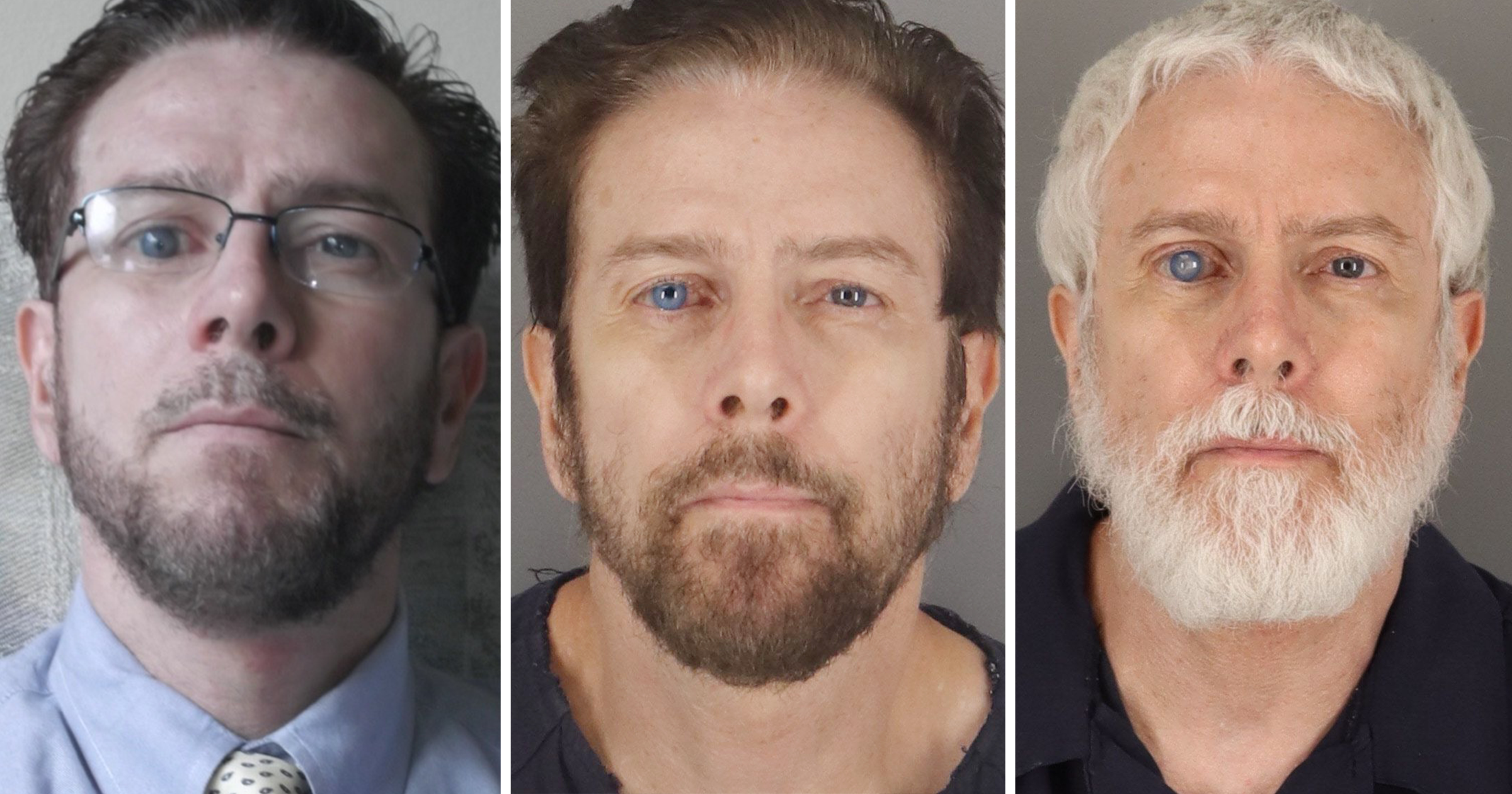
Bordages (before), Bordages (arrested), Bordages (now)