

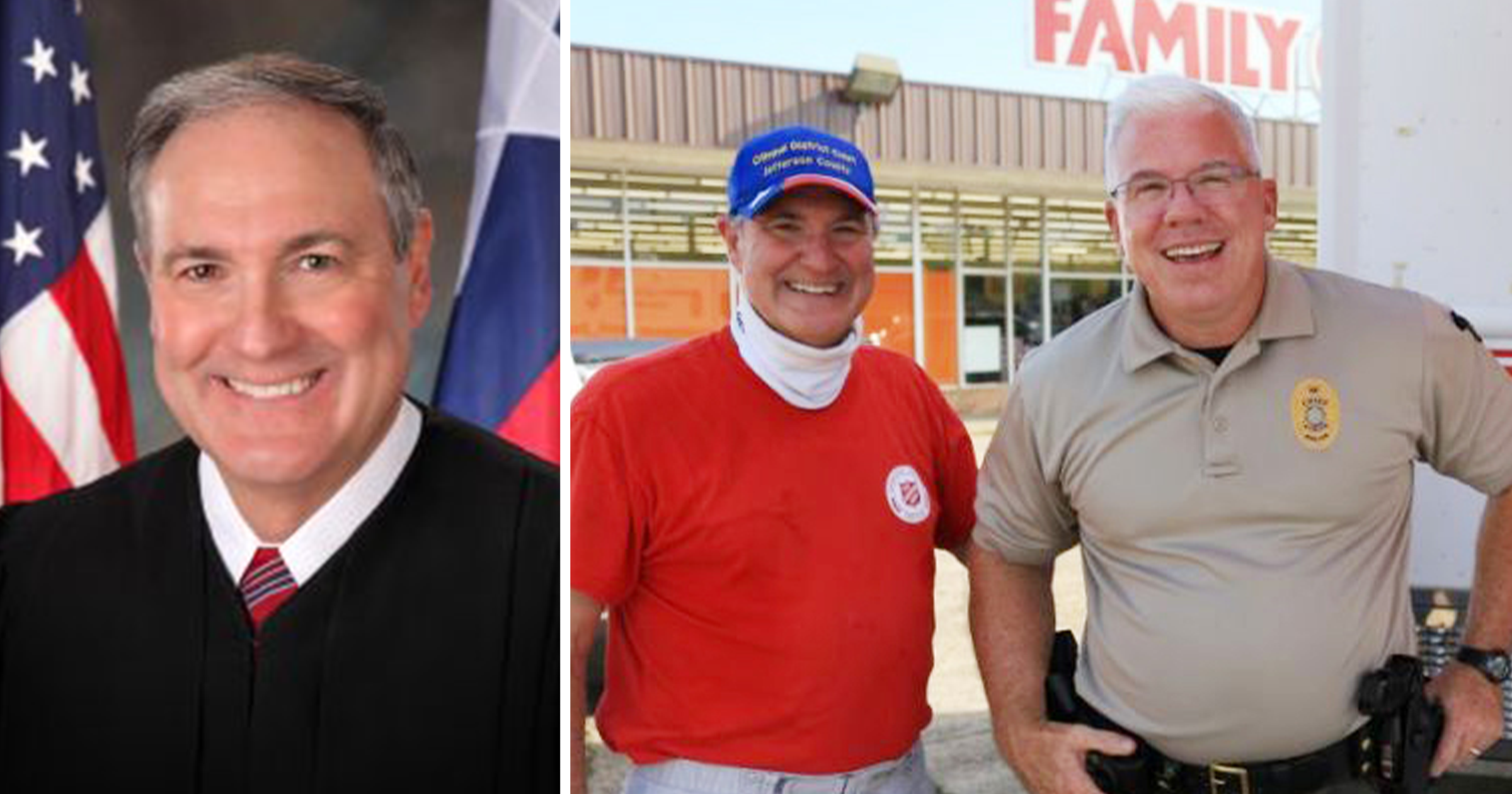
After having served nearly 20 years and presiding over 600 trials as Jefferson County Criminal District Court Judge, John Stevens Jr. is committed to continue serving Southeast Texans as part of the judiciary. Speaking with The Examiner, Stevens confirmed intent to seek a sixth term of office when the position is up for re-election in 2026.
In addition to the 600 trials taking place under his charge, Stevens has facilitated the disposition of thousands of criminal cases since taking charge of the Criminal District Court bench in 2007, many of which represent the most serious of criminal offenses including murder and crimes against children. Daily duties also include overseeing probationers, reviewing warrants, setting bonds and so much more. Still, the veteran public servant finds time to serve his community outside the walls of the Jefferson County Courthouse — a practice instilled in Stevens at a very young age.
Born Boy Scout
Born in Port Arthur, Stevens moved to Groves with his family in elementary school. Settled in a residence off of Hogaboom Road, Stevens fondly recalled days with his best friend, Gary, and working hard to earn Eagle Scout status as a member of the Boy Scouts of America. Among the survival skills learned in scouting was what to do in the event a person is set afire — little could he know that his training would be called upon while he was still a child.
“Gary and I were playing catch, and I heard something that sounded like thunder. It was a cloudless sky.
“Then I heard screaming,” Stevens said.
Neighbor Mike Warner, as well as two other children, then ran from the direction generating the “thunder.”
“I see three people, little kids; Mike was on fire from head to toe, all running and screaming,” Stevens shared, adding that the scene from that long ago day has forever remained as vivid in his mind as the day it happened. “Mike was leaving a trail of fire behind him in the grass. I remember hitting him with my baseball glove to put out the flame – and it kept reigniting.
“My dad came out with his jacket and smothered the fire. Mike’s back was the only part of his body that wasn’t burnt. They said he would die, but he didn’t. Mike’s little brother did die from injuries he sustained that day.”
Without intervention, Mike’s family could have buried two children from that day.
“As an Eagle Scout, they teach you those things, thank God. That’s what I do, I run to the catastrophe,” Stevens said. “It taught me how to save lives – and it saved him.”
Award of the Optimist Club Award for Saving a Life and various Boy Scouts awards never overshadowed the pride in being able to be of service when most needed, the judge shared.
“That still haunts me,” he said. “Things like that you don’t forget. You never know when you going to have a purpose. When that time comes, you want to be prepared.”
Manning up
“The day I turned 16, I started working at Dixie Cream Donut Shop in Groves — at 80 cents an hour,” a happy memory, he shared. “I work hard. It’s in my DNA. I serve the people. It was perfect.”
It wasn’t long after, while in college cultivating a friend group at the University of Texas at Austin, Stevens was drawn to the legal profession. Fresh from graduating at the University of Houston College of Law, Stevens returned to Southeast Texas and practiced as an associate attorney with the Provost Umphrey Law Firm; he was still employed as a civil attorney when the opportunity for public service arose. Then-U.S. Attorney for the Eastern District of Texas Bob Wortham, of Beaumont, presented Stevens with employment as a federal prosecutor. Stevens would flourish in that sector for the next 20 years, attaining the rank of Criminal Division chief and receiving orders directly from United States Attorney General Janet Reno to lead prosecution in the hate crime dragging death of James Byrd Jr. in Jasper County in 1998.
Remembered as a crime so heinous that future laws were enacted to deter similar acts, Byrd’s murder by a group of three white supremacists precipitated unprecedented action by the U.S. government in Southeast Texas. Stevens was proud to be a member of the justice-seekers and remembers getting the call from Reno herself.
“I think I stood up and saluted the phone,” he laughed. “If she says, ‘Go,’ you go. She was no-nonsense.”
Inundated in the details of a brutal hate crime that still haunts his memory, Stevens said he could feel the great need for justice to be served.
“Life just changed,” he reflected. “We worked hard on it. People expected justice.”
Stevens worked the prosecution of the first two defendants and secured a death penalty for the accused. By the third defendant’s trial, Stevens was trying capital cases all around the country – and the world, representing the U.S. with training for high-stakes prosecutions in the Republic of Georgia and Bangladesh. For his efforts to attain justice for the American people, Stevens was honored with commendations including the U.S. Department of Justice’s highest commendation, the Attorney General’s Award for Exceptional Service, in 2000.
After 20 years and up for retirement on a Friday, Stevens left the U.S. Attorney’s Office and filed for the elected office of Jefferson County Criminal District Court judge the following Monday in 2006. He entered private practice as a contract attorney with the Reaud, Morgan & Quinn law firm and readied for a highly contested race among a field of six candidates for the office.
By 2007, Stevens claimed voter support and took the bench of the Criminal District Court; he ran unopposed in the next four elections.
‘We the people…’
Commitment to upholding the values of the Constitution of the United States of America is Stevens’ stated platform, a promise portrayed in much of the judge’s published professional papers seen in print for the Texas Center for the Judiciary, Texas Bar Journal, Federal Prosecutors Handbook, U.S. Department of Justice, Juvenile and Child Welfare Law Reporter, and National School Safety Center News Journal.
“Right out of the box, they were talking to judges,” Stevens explained as he recited the Constitution’s preamble and No. 1 order of business – establish justice. “Judges should never make decisions on ‘party platform.’ You don’t take an oath to a party.
“Our decisions are made on the law, the circumstances, and fairness.”
Evolution of law, occurring as practice leads to perfecting, has spurred Stevens to authoring peer-reviewed leading expert papers covering two main components of criminal trial law: the “presumption of innocence,” and certainty of guilt “beyond a reasonable doubt.”
“The more you try, the more you see, the more you learn,” Stevens said, pointing to the 600 bench trials to his credit. “None of the cases are the same. Some are very unique; but, when you try a lot of cases, you get a lot of insight.”
Although Stevens has tried a lot of cases, many more are awaiting disposition. According to Stevens, with Jefferson County posting the 16th highest crime rate in the great state of Texas, more criminal cases are filed than the two criminal district courts can complete expeditiously. Roughly 5,000 felony criminal cases are filed annually; the maximum number of trials a court can see is estimated at 35 – 40 per year.
“We’re still behind – but we work hard,” the judge shared, adding that most cases are concluded without a trial, mostly with some form of probation. For probationers in Jefferson County, the group fairs better than most other areas, boasting a higher than 90% success rate, compared to the national average of 75% success. “I, and my team, are very proud of the work we have done and are anxious to continue the great work.
“This area has a problem with crime. But we are fighting the fire as fast as we can.”
Love what you do
Stevens’ work isn’t confined to the courthouse, though. As self-ascribed “professor in a past life,” Stevens’ spare time has been spent educating others about the rule of law, volunteering in community service initiatives such as hurricane assistance for impacted victims, teaching at Lamar University, serving as a Nederland ISD school board trustee, supporting the arts, giving time to basketball officiating, fundraising for various local nonprofits, Boys and Girls Club participation, and the like. He has served on premier committees and boards for the Texas Bar Association, Second Administrative Judicial Region of Texas, the 100 Club of Southeast Texas, State Bar of Texas, Boy Scouts of America, Salvation Army, Boys and Girls Club, YMBL, and Beaumont Catholic Diocese.
Along with wife, Marcia, “a beautiful woman,” board-president-elect of the Art Museum of Southeast Texas, Stevens makes community a priority. For his service to Southeast Texas, Stevens has received awards from the Jefferson County’s Sheriff’s Office, Julie Rogers “Gift of Life” Program, Dr. MLK Jr. Support Group, American Red Cross, St. Thomas More Society, 100 Club of Southeast Texas, to name a few. Professionally, in addition to commencement addresses solicited for a number of local institutions, Stevens is quite proud to be routinely included in the Baylor Law School “Top Gun National Mock Trial Competition,” where he gets a front row seat to the future practitioners of the legal profession.
Above all, Stevens is proud to serve his hometown as Criminal District Court judge – a responsibility he takes to heart.
“How important is it? Our forefathers put it first,” Stevens said of the rule of law. “What we do establishes justice one way or the other.
“My belief is the world’s a better place because of the work we do.”
.

.