

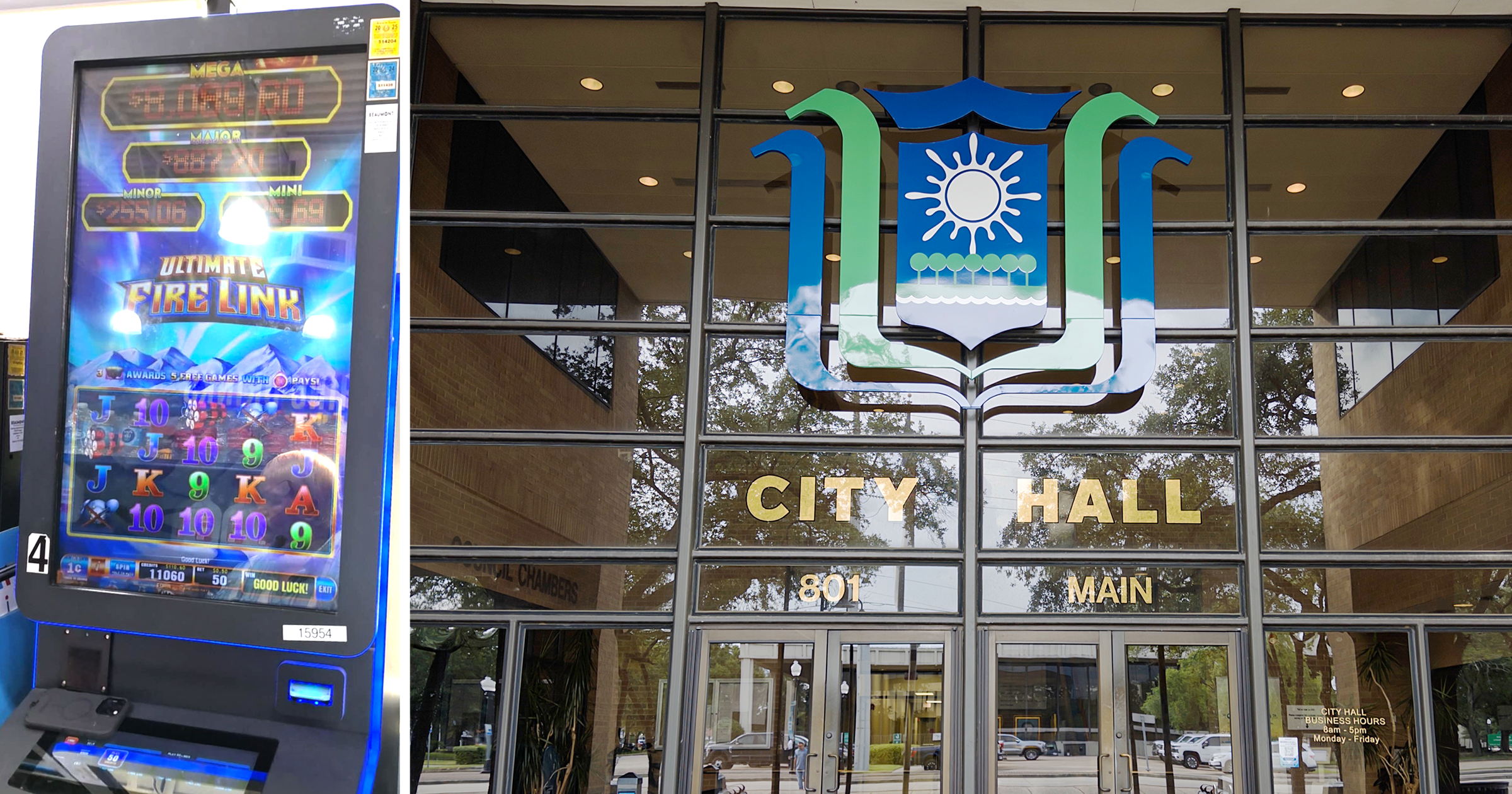
After months of drawn-out debate, procedural detours and rising public tension, the Beaumont City Council voted unanimously July 29 to amend Article 6 of the City’s Code of Ordinances — effectively banning 8-liner gaming machines within the city limits.
The decision marked a dramatic shift in city policy and comes after a prolonged saga in which city officials, business owners and concerned residents grappled with the increasingly controversial presence of game rooms and accessory gaming machines — collectively called “8-liners,” or electronic slots commonly accused of fueling violent crime, financial instability, and legal confusion across Southeast Texas.
Unlike previous council meetings characterized by spirited exchanges, the July 29 vote was somber and succinct. No member of council offered personal comments ahead of the decision, though public input was heard before and during a mandated public hearing.
Two individuals spoke at the hearing in defense of local businesses relying on the machines.
Muhammad Naeem, owner of the Shop N Go at 2305 Louisiana Ave., pleaded with council to reconsider the ban’s economic impact.
“This ban would place significant burden on our business, forcing some of us to shut down entirely,” Naeem said. Prior testimony from the public podium to city council argued that there was little fiscal gain from the machines. “Neighboring cities continue to allow these machines and it would be unfair to single out our city. We ask you to allow our business to continue operating while awaiting legislation from the state level. We are law-abiding business owners who pay taxes, employ local residents and contribute meaningfully to our local economy.”
Azim Sumar, a Nederland resident who owns A&T Food Mart on Magnolia Street in Beaumont, focused his testimony on legal precedent.
“I understand the concerns that have led to this proposal, and I appreciate the effort to protect the integrity of our community,” Sumar said. “However, I respectfully ask the council to consider broader legal economic implications moving forward.”
Sumar cited the Fort Worth v. Riley case, arguing that the resulting appellate decision is not binding in Beaumont’s region and that no new state law has authorized such a ban.
“Under the Texas Constitution, city ordinances cannot conflict with state law,” Sumar continued. “Many of us here operate with valid licenses and permits issued by the state of Texas. Unless those licenses are revoked by the state, I respectfully submit that the city should not invalidate them.”
He concluded by warning that the city could face prolonged and costly litigation should businesses choose to challenge the ordinance in court.
The July 29 vote follows a chaotic and politically fraught path to policy change.
Two weeks earlier, at the July 15 meeting, a vote on a complete ban was expected — instead, council was presented with a softened version authored by Planning Director Demi Engman. The staffer’s proposed amendment restricted game rooms to industrial zoning areas, a measure many on council saw as a nonstarter that failed to address the growing public demand for decisive action.
“That’s not the ban — it’s this compromise, or whatever you call it, that was not expressed by the council,” Councilman Cory Crenshaw said at the time.
Councilmember Mike Williams moved to reject the item entirely and requested a new ordinance for a full repeal be brought back for a straight vote. The motion passed unanimously, setting the stage for the final decision July 29.
Attempts to call a special meeting for July 22 to address the issue sooner were unsuccessful. Although Williams, Crenshaw, and Councilmember Joey Hilliard supported the move, Mayor Roy West declined to convene a special session, citing scheduling conflicts. The delay, while procedural, was emblematic of the drawn-out and often frustrating nature of Beaumont’s journey toward a gaming ban.
The push to outlaw 8-liners is rooted in a history of crime, regulatory ambiguity and community backlash. Since 2021, Jefferson County’s own game room regulations have noted the association between such establishments and violent crime, illicit drug trafficking and urban blight. In Beaumont, county concerns have played out repeatedly.
In one particularly harrowing case, Pick N Shop owner Mettha Kurrupu was murdered during a robbery tied to gaming operations in 2015. Other cases of armed robbery, including a machete attack earlier this year, have made headlines and hardened public opinion.
Despite arguments from some business owners that the machines are primarily entertainment devices, residents and law enforcement have long alleged that cash payouts — illegal under Texas law — remain common, though typically reserved for “regulars” and hard to prove.
Game rooms have proliferated in low-income neighborhoods. While business representatives such as Shahzaib Nizamani have previously claimed the machines provide critical economic lifelines and generate hundreds of thousands in city revenue through fees, officials have clarified that all income from machine decals and badges merely covers administrative costs.
According to City Attorney Sharae Reed, the new ordinance will take effect over the course of 90 to 120 days, during which time permit holders will be notified and machines phased out.
How aggressively the city will enforce the new ordinance remains to be seen.
Still, the elected city leaders’ position is now clear. After years of inaction, tragedy, legal ambiguity and mounting public pressure, the game is over – at least, for now.
.