

The judicial system is facing significant delays and increased expenses due to the rising demand for translation services in courtrooms locally and across the United States. With the growing diversity of the population, courts are finding it increasingly challenging to provide timely and accurate translations, which is impacting the efficiency of legal proceedings and placing a financial strain on county budgets.
According to Jefferson County Criminal District Court Judge John Stevens, Jefferson County is no exception.
“I’ve got to go to Houston to get certified translators,” said Stevens. “We are struggling, and, we have these hearings about every third Friday.”
As the demographic landscape in the U.S. continues to evolve, the need for translation services in courtrooms has surged. Non-English speakers, including immigrants and refugees, often require the assistance of court interpreters to fully understand legal proceedings and to effectively communicate during hearings and trials. This has resulted in a greater demand for skilled interpreters fluent in various languages, but primarily Spanish here in Jefferson County.
“I have to bring in two translators … pay for their travel and pay for their time. It’s very expensive,” said Stevens.
According to Jefferson County Auditor Fran Lee, during fiscal year 2024 to date, the county has spent $33,159.97 on translation services, which is a significant increase from the $26,607.08 spent in the entirety of fiscal year 2023.
The criminal court isn’t the only courtroom in need of translators, either. As explained by court personnel, the Houston-based MasterWord Services agency is also utilized in the District Clerk’s office to support passport production, as well as in the family courts of Jefferson County – where translators are most needed. The local users “do not get to pick who comes by,” but all that have been sent have been used.
The quality of the work provided by the out-of-town translators has not been a problem, according to Stevens and other courthouse staff.
“The mileage,” they said, “that’s what kills us.”
According to the National Center for State Courts, there has been a steady increase in the number of cases requiring interpretation services over the past decade. In states like California, Texas and New York, where multicultural populations are most concentrated, courts are finding it particularly challenging to keep up with the demand.
The requirement for translation services significantly slows down court processes, according to those manning the dockets. Court interpreters need time to ensure that all parties understand the proceedings, which can lead to extended hearings and trials. In many instances, cases must be postponed or rescheduled due to the unavailability of qualified interpreters, which often means more jail time and further delays of justice.
The increased need for translation services comes with a hefty price tag, as revealed in the county auditor’s data. Counties are responsible for covering costs associated with hiring interpreters, which can range from $50 to $150 per hour, depending on the language and expertise required.
To address these challenges, some courts are exploring alternative solutions, such as remote interpreting services and the use of video conferencing technology to connect with interpreters not physically present in the courtroom.
Sarah Hillin, head of modern languages at Lamar University, has been tasked to work on getting former students prepared and certified.
“We can use as many as we can get,” Stevens said of efforts to supply the demand. “It costs the county a lot of money, and we can keep that money in Jefferson County.”
Attempting to block together defendants in need of interpreter service has resulted in a full day of cases brought before Stevens on most weeks, costing taxpayers hourly wages, travel costs and meals for two interpreters to drive in from Houston. Stevens is adamant that those tax dollars could be better served in the hands of Southeast Texans.
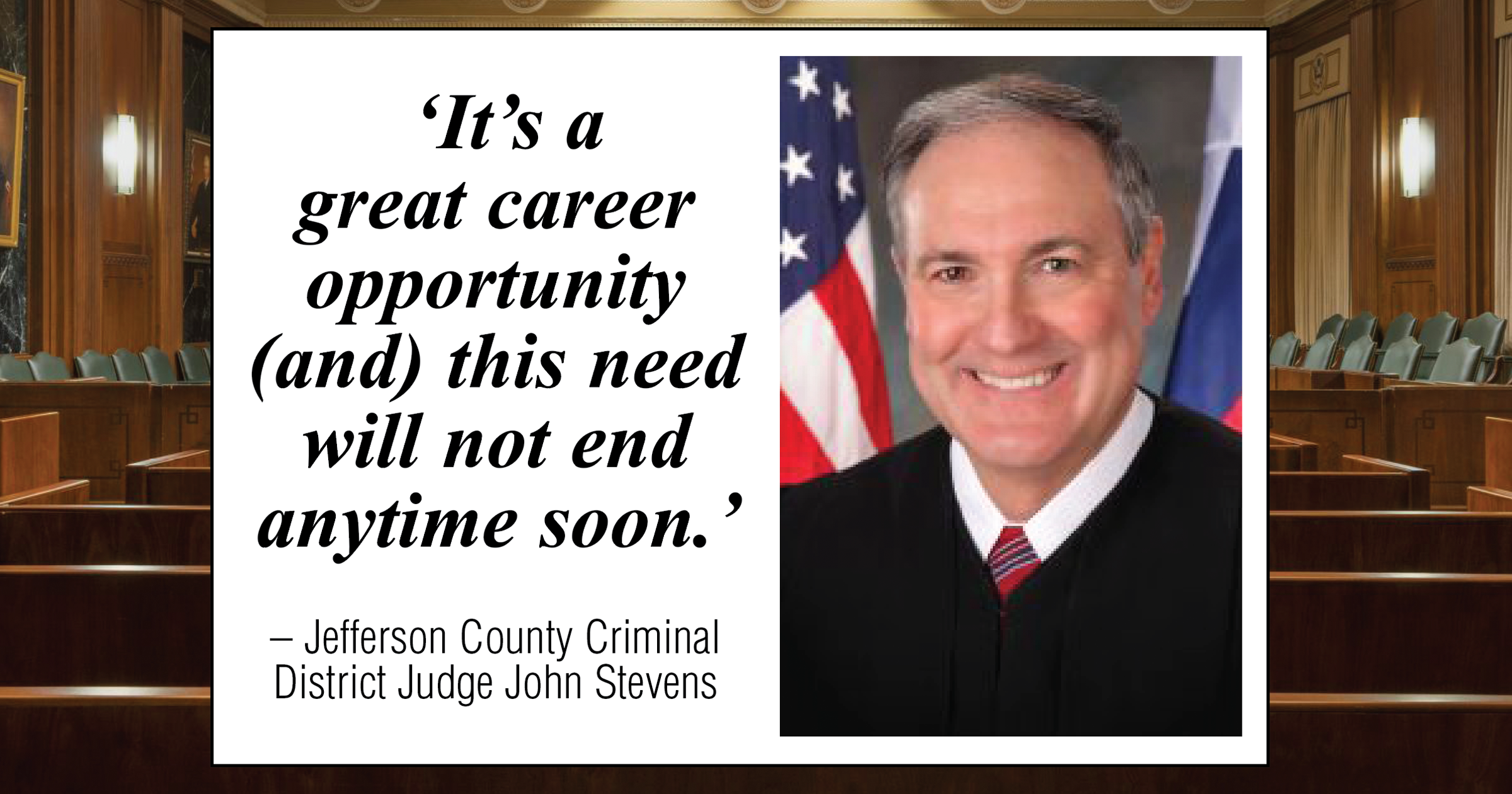
“We have too much of a supply here to not have the people working for us from here,” said Stevens. “It’s a great career opportunity, and this need will not end anytime soon.”
For those interested in becoming a Licensed Court Interpreter in Texas, the first step is to complete a six-hour orientation accredited by Judicial Branch Certification Commission (JBCC). After the orientation, individuals can apply to take the written exam. The last exam for the year is scheduled for Oct. 15 with a registration deadline of Sept. 15. More information on licensing can be found at https://www.txcourts.gov/ jbcc/licensed-court-interpreters/.
“We’ve got a lot of work in this county for Spanish translators,” Stevens said, urging Golden Triangle bilingual residents to take up the trade. “They can make a lot of money.”
.