

Despite announcing that it will no longer operate as a “full-service department,” officials from the Beaumont Police Department (BPD) are adamant that the community will benefit from what is arguably defined as decreased service from those sworn to serve and protect.
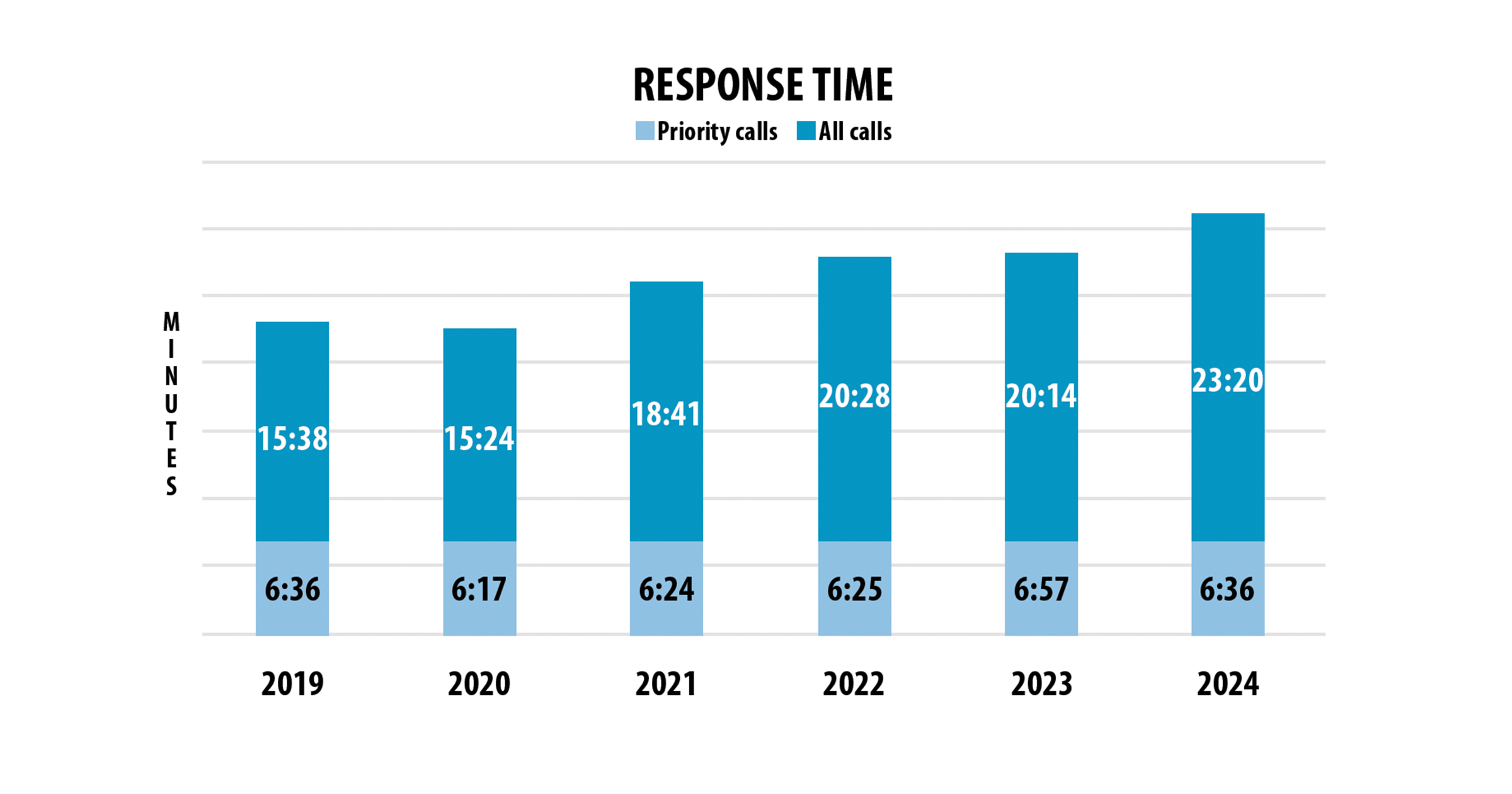
During a work session of the Beaumont City Council on Feb. 4, elected officials reviewed the BPD Response to Calls report. The report highlighted an average response time of 6 minutes and 36 seconds for life-threatening priority calls, a serious concern that BPD Chief of Police Tim Ocnaschek emphasized must be addressed.
Historically, BPD has operated as a full-service department, meaning that when citizens called 9-1-1, an officer responded to the scene. However, Ocnaschek noted that many cities of similar size no longer maintain full-service departments. He pointed out that these cities have experienced improved response times and increased police visibility as a result of their adjustments.
BPD currently responds to approximately 140,000 calls per year, with many requiring multiple officers to be dispatched to different locations, BPD data delineates.
“Our officers have little free time to initiate stops or conduct proactive patrol between calls and paperwork,” Ocnaschek stated during his presentation to the city council.
The chief acknowledged that both the council and the community have expressed a desire for a more visible police presence. But, he explained, achieving a goal of increased visibility is challenging without implementing changes to allow for more downtime between calls.
To address this issue, BPD has identified eight offenses that typically do not require an on-scene investigation. Beginning Feb. 17, reports for these offenses will be handled over the phone:
• Minor assault – after the fact when no immediate medical attention is needed or ongoing threat exists. All family violence assault calls will have an officer dispatched to the scene.
• Auto burglary – when no suspect is present.
• Criminal mischief – such as vandalism or property damage that has already occurred.
• Forgery/fraud – cases where no suspect is actively involved at the time of reporting.
• Harassment – where there is not an immediate threat to safety.
• Identity theft.
• Threats – where there is not a present threat.
• Theft – where there is not a present threat.
Recent reports indicate that BPD’s average response time is currently the highest it has been in years, with an average of 23 minutes and 20 seconds to respond to non-priority calls. Ocnaschek explained that over 4,000 calls per year could potentially be handled over the phone, which is equivalent to the annual workload of two full-time officers.
Despite the shift in handling certain reports over the phone, BPD reassures citizens that every call will still be answered by a live dispatcher, rather than an automated system.
“Every call will be monitored and assessed by its own merits,” said Ocnaschek. “If there is a present danger or the call requires an on-scene investigation, an officer will be dispatched.”
Currently, BPD takes approximately 1,000 police reports by phone without dispatching an officer. Although there are multiple ways to file a police report, Ocnaschek noted that the resources are often underutilized.
Community members can file non-emergency reports through BPD’s online reporting system at https://beaumonttx.policetocitizen.com/Home; via BPD’s non-emergency number at (409) 832-1234; through the Teleserve Unit that allows citizens to report minor incidents by phone, Monday-Friday, 8 a.m. – 5 p.m. at (409) 880-3862; and in person at BPD Headquarters, 255 College St. in Beaumont, Monday – Friday, 8 a.m. – 5 p.m.
Ocnaschek emphasized that, under the current mode of operation, officers are frequently pulled from other calls or must respond to incidents across town, outside of their patrol zones.
“Our goal is, hopefully, they’ll be able to stay more in their area of assignment, which would mean a much faster response time,” he said, adding that, in addition to reducing response times, the change could lead to more successful investigations, as witnesses would be more likely to remain on the scene.
When asked if BPD has a staffing shortage, Ocnaschek responded, “I guess you could look at it as a staffing shortage or just the way we’re doing business needs to improve for efficiency – and, this is a way that does not cost any more money, but it makes us a more efficient department.”
Beyond decreasing response times, Ocnaschek’s broader stated goal is to increase police visibility and allow officers more time to patrol neighborhoods, conduct welfare checks, enforce traffic laws and engage with local businesses.
As of the most recent recorded data available from the department, BPD has 260 sworn personnel, with 197 police officers below Sergeant level. The department currently has 8 vacant police officer positions.
Overall, Beaumont’s crime rates are elevated compared to both state and national averages for cities of its size. According to local statistics, Beaumont’s combined violent and property crime rate is 47 per 1,000 residents, placing it among the highest in the nation. Specifically, residents face a 1 in 73 chance of being a victim of violent crime and a 1 in 30 chance for property crime victimization.
When compared to other cities with populations between 100,000 and 250,000, data indicates Beaumont has a violent crime rate of 1,032.2 per 100,000 residents, substantially above the national average for cities in this population range. In comparison to Waco – a city of similar size – Waco has 42% less violent crime and 15% less property crime than Beaumont.
According to BPD Public Information Officer Haley Morrow, officers will continue to respond immediately to all crimes in progress.
“If you are in danger, call 911 – we will be there,” said Morrow.
.
Source: Beaumont Police Department
.
.