

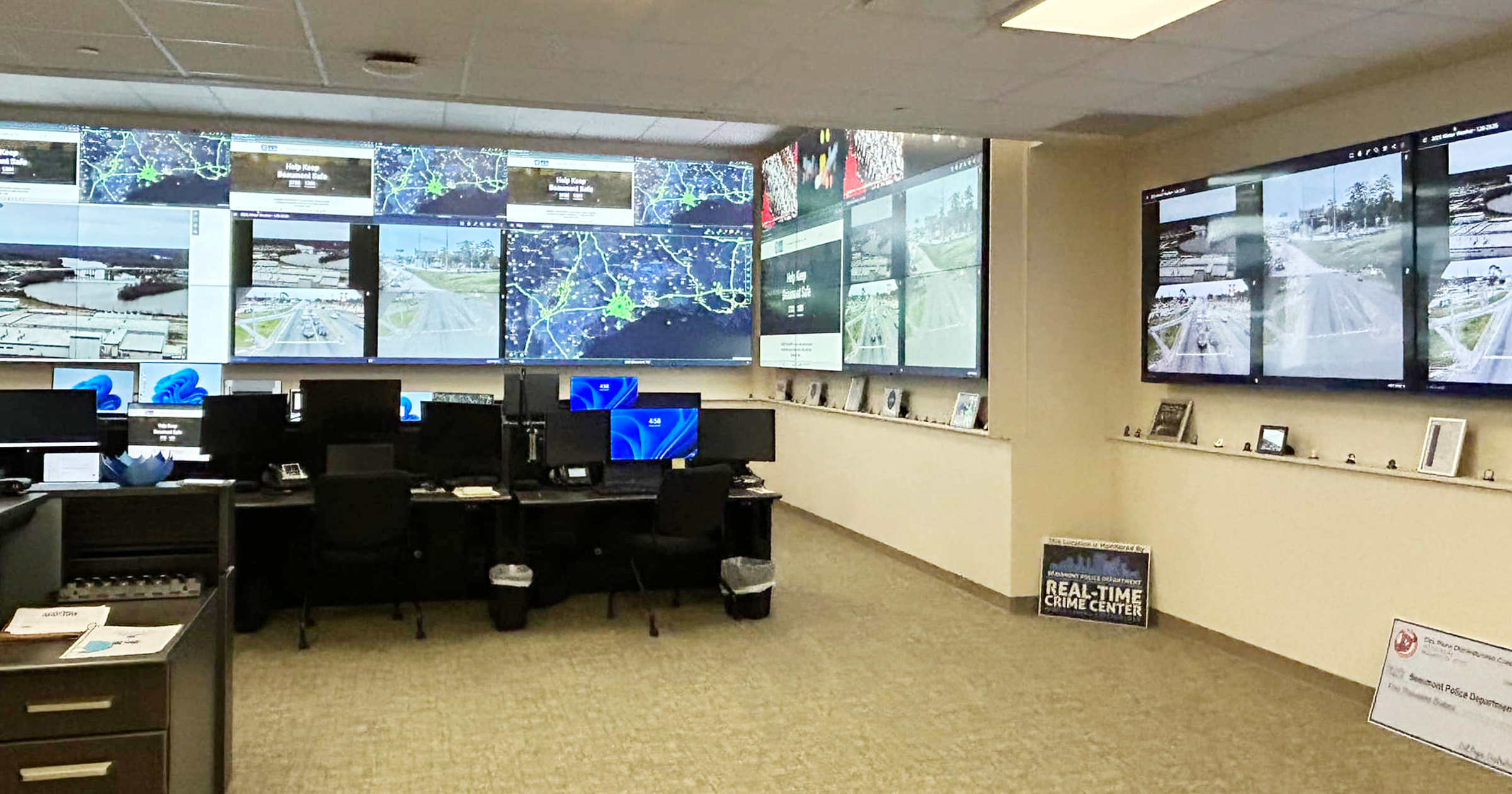
This month marked a year of operation for the Beaumont Police Department (BPD) Real Time Crime Center (RTCC), billed as an invaluable tool for law enforcement to track crime – and solve cases – with speeds never before imagined. According to Officer Haley Morrow, BPD public information officer, the police department has seen “great success” with the RTCC.
“We’ve assisted in over 250 cases, ranging from something simple like a theft, all the way up to a homicide and, of course, missing persons,” she said. “We’ve worked with over a dozen agencies on cases from El Paso to Alabama and everywhere in between.”
According to Morrow, the RTCC has access to nearly 3,000 registered cameras and more than 1,400 integrated cameras.
“We just always want to remind citizens that registered cameras are what we want for residential,” she explained. “If you have a Ring doorbell camera or some type of surveillance system at your home, go to ConnectBeaumontTX.org and register your camera.”
Morrow said a registered camera provides a dot on a digital map that lets the RTCC and detectives know there is a camera at that location. The camera is not monitored by police, and will only be utilized in the event that the feed is needed to fight crime.
“It takes less than one minute for people to fill out the registration form and it literally is your name, phone number, email address, the address that the cameras are at, how many internal cameras and how many external cameras,” she added.
According to Morrow, the information is important in the event that police are investigating, for example, a string of automobile burglaries in a neighborhood.
“Our detectives can pull up our camera registry map. They can draw a circle around all the streets or areas that they are hoping to request footage from, and it will send an email or a text message to the person who has registered cameras at that location that states: ‘This is a community connect request that the police department is investigating a case. Can you please check your cameras between this date and this time if you've seen anything that can help our case, would you please download the video and send it back to us?’” Morrow detailed. “And that’s it.
“We don’t need access to cameras at everyone’s home, so it gives that peace of mind when it comes to privacy.”
Registered cameras also significantly streamline police work, Morrow further explained, which is part of the reason BPD has attended more than 150 community meetings to rally community support for the program.
“Detectives used to have to drive out to the neighborhood, canvas the neighborhood, knock on doors, hope somebody’s home and to see if their camera works,” Morrow noted.
Together with integrated cameras, the community can assist with being witnesses when no one is watching. Integrated cameras, Morrow said, are best utilized from businesses, schools, public places and anywhere the public frequents, like convenience stores, restaurants, bars, etc.
“In the event there is an incident at that location, when a camera is integrated, that gives our real-time crime center access,” she added.
Morrow said the integrated cameras helped BPD solve the August 2024 shooting at the SNS Grocery Store on Concord Avenue. By October 2024, Brian Keith Murphy, 32, pleaded guilty to being a felon in possession of a firearm when he fired at people and cars that day.
“So, with being integrated, we were able to have a patrol sergeant immediately start watching the last footage, giving that information to officers that were responding and, as the officers were pulling up, we knew exactly what vehicle he had gotten into and exactly where he was,” Morrow said of the suspect. “And, as his vehicle was pulling out into the street, we were there and knew that that was a suspect vehicle.”
In the past, Morrow said, officers without the type of information available for the August 2024 shooting were going into chaotic scenes where people are scattering, meaning longer investigation times to figure out who was involved, what they did and where they went.
“That’s extremely successful in high stress situations and, of course, it helps with officer safety, as well,” Morrow said.
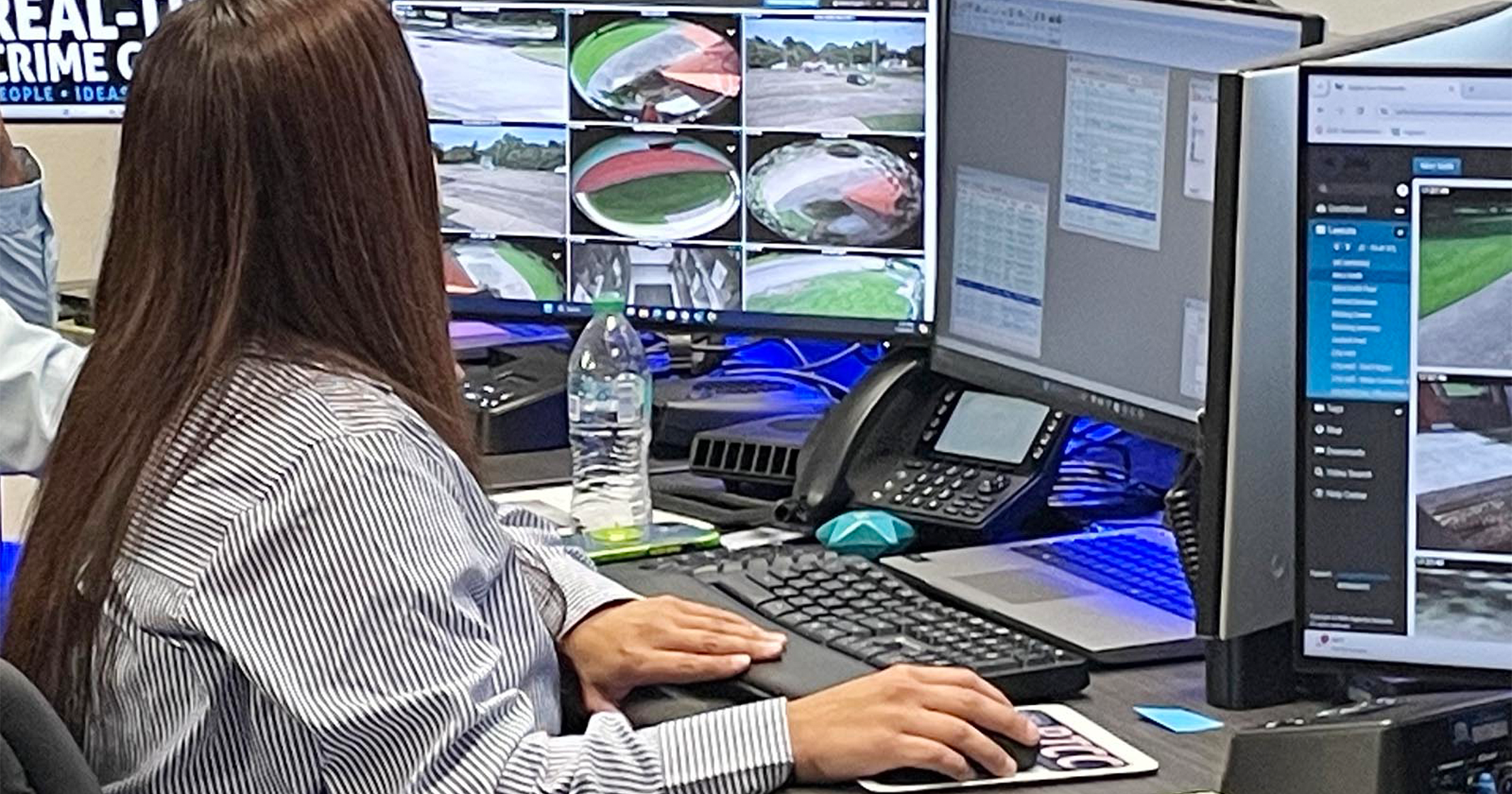
According to Morrow, BPD has more than 100 license plate readers across the city, which have been useful in recovering stolen vehicles and tracking suspect vehicles. Morrow noted that all BPD officers have access to the RTCC on their cell phones.
“They’re able to use this technology to continue their investigation right there on the street, instead of just taking the basic information and sending it in to have detectives check into it the next day,” she explained. “Our patrol officers are able to work it enough to where, sometimes, they’re able to find the suspect almost immediately after they’ve taken a report or responded to a scene for something.”
“As people (fill) their homes with cameras, the more chances we’re able to solve a case quicker, catch a suspect quicker,” Morrow said. “Having the ability to reach out when we know that there’s been a drive-by shooting in the area, or a homicide in the area, it lets the citizens almost become detectives for themselves.
“It’s really the ultimate teamwork in keeping our community safe and that’s really what we need is for everyone to come together and help us.”
.
.
.