

It has been nearly two years since the Beaumont Police Department’s Real-Time Crime Center (RTCC) was officially implemented. Since then, according to previous reports from The Examiner, BPD has been able to utilize the technology to solve various crimes such as the August 2024 shooting at the SNS Grocery Store on Concord Avenue and, more recently, in the arrest of Steve Ray Williams, who stole a vehicle with the victim’s 3-year-old son still inside.
According to the Bureau of Justice Assistance, the mission of a RTCC is to provide a law enforcement agency with the ability to capitalize on a wide and expanding range of technologies for efficient and effective policing. These efforts may help law enforcement officers to respond quickly, or even immediately, to crimes in progress or to those that recently occurred. The technologies available allow law enforcement agencies and officers to respond to crime events more efficiently, more deliberately, with improved operational intelligence, and with a proactive emphasis on officer, citizen, and community safety.
The development of RTCCs is a response to the police community’s stated desire to provide immediate information to officers during each call for service. The RTCCs are intended to initially organize information from a call for service and provide information, such as suspect vehicle descriptions, victim or suspect criminal histories, and other pertinent information, on the fly to assist in furthering an officer’s investigation during a call. But, because of the vast quantity and limited quality of preliminary calls for service information, RTCCs are designed to assist only with certain types of calls for service with specific information that can be used within the time span of an initial call.
With BPD already investing in the technology to run a RTCC, nearby municipalities are signing on to join the initiative. BPD currently has local agencies such as Vidor, Groves, and Sour Lake online, as far as video cameras, with several other cities in the works, BPD Lieutenant Cody Courts said.
“The most important thing we do is what we’ve been doing all along, connecting with the community and getting more people from the community involved in the crime center,” he said. “But, I think even just as important as the city being safe from crime and from violence is felt safety” the RTCC further remarking that there’s lots of areas in Beaumont where people do not feel safe going.
“We’re hoping that by (people) knowing the crime centers are there and that, if something does happen, we can respond in a more effective way, people will feel more safe when they’re out shopping or working or doing whatever else in the city,” Courts added.
Courts said that RTCC equipment is primarily funded through grants and donations, with other counties planning to do the same, or pay to access the equipment through Beaumont’s RTCC. This is also the case because most of the video that the crime center uses is through consent with businesses and individuals.
“We’re hoping to get some more businesses on board with video sharing and educating our officers on how to use that equipment that they have right now,” he said.
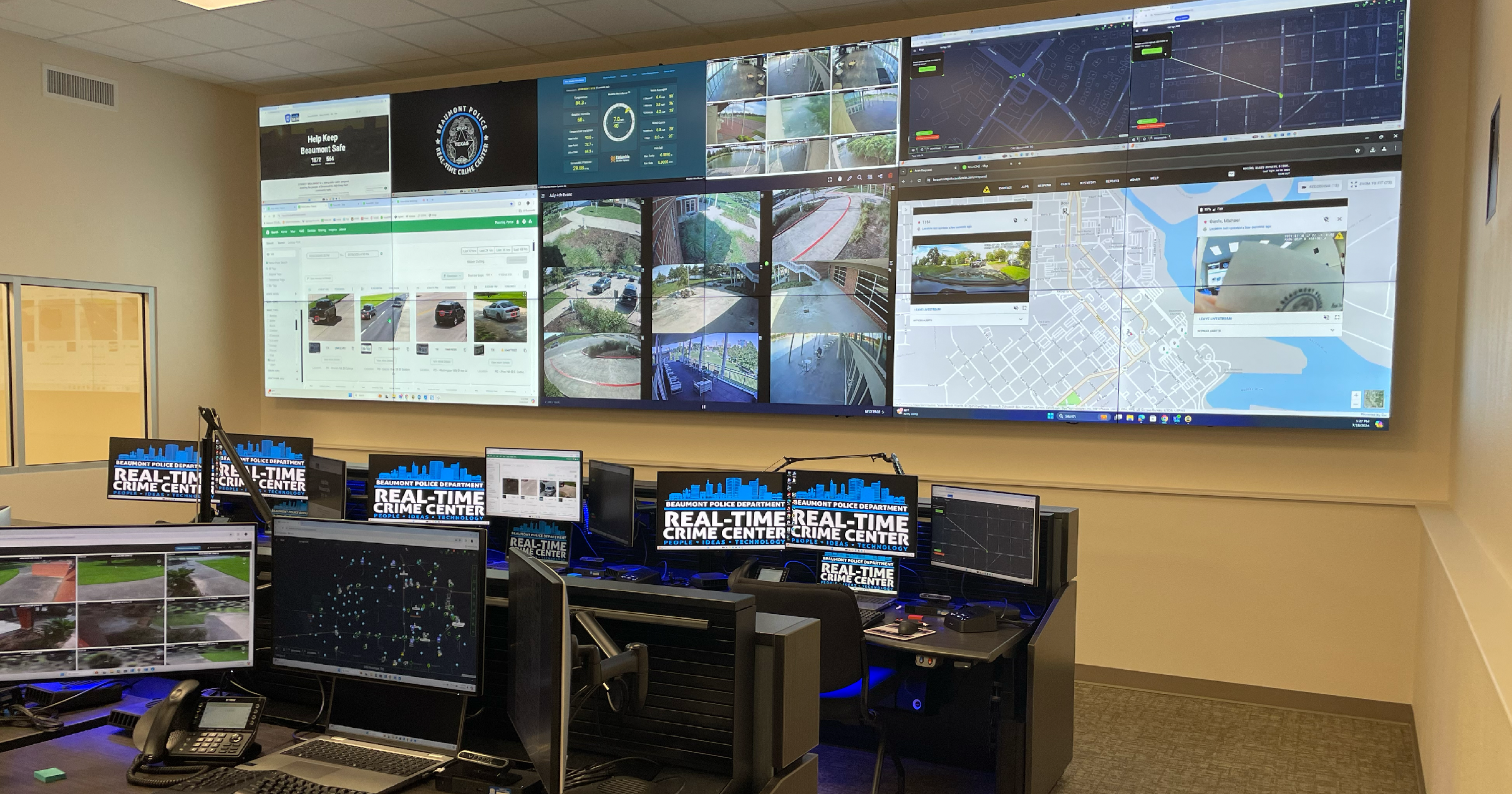
As of last count, the RTCC has access to nearly 3,000 registered cameras and more than 1,400 integrated cameras. Additionally, the RTCC has more than 100 license plate readers across the city, which have been useful in recovering stolen vehicles and tracking suspect vehicles; and, BPD officers have access to the RTCC on their cell phones, giving them more ways to utilize the technology, with plans to expand operations to 24/7 surveillance in the future.
“The community response has been almost universally excellent, especially when people come to our facility and do a tour and really understand what we’re doing,” Courts explained. “We have been just as transparent as we can possibly be without jeopardizing investigations and ongoing cases. We’ve had a lot of people that want to work at the drive center. In our last hiring process that just wrapped up, we were hiring four positions, and we had over 100 applicants for those four positions.”
Going into 2025, the RTCC celebrated one year of operation. At that time, the department was hoping to see the growth now being reported.
The RTCC, even then billed as an invaluable tool for law enforcement to track crime – and solve cases – with speeds never before imagined, was heralded as a “great success,” according to BPD Officer Haley Morrow, then the BPD public information officer.
“We’ve assisted in over 250 cases, ranging from something simple like a theft, all the way up to a homicide and, of course, missing persons,” she said. “We’ve worked with over a dozen agencies on cases from El Paso to Alabama and everywhere in between.”
“We just always want to remind citizens that registered cameras are what we want for residential,” Morrow urged then, echoed now by Courts. “If you have a Ring doorbell camera or some type of surveillance system at your home, go to ConnectBeaumontTX.org and register your camera.”
Morrow said a registered camera provides a dot on a digital map that lets the RTCC and detectives know there is a camera at that location. The camera is not monitored by police, and will only be utilized in the event that the feed is needed to fight crime.
“It takes less than one minute for people to fill out the registration form and it literally is your name, phone number, email address, the address that the cameras are at, how many internal cameras and how many external cameras,” she added.
According to Morrow, the information is important in the event that police are investigating, for example, a string of automobile burglaries in a neighborhood.
“Our detectives can pull up our camera registry map. They can draw a circle around all the streets or areas that they are hoping to request footage from, and it will send an email or a text message to the person who has registered cameras at that location that states: ‘This is a community connect request that the police department is investigating a case. Can you please check your cameras between this date and this time if you’ve seen anything that can help our case, would you please download the video and send it back to us?’” Morrow detailed. “And that’s it. We don’t need access to cameras at everyone’s home, so it gives that peace of mind when it comes to privacy.”
Registered cameras also significantly streamline police work, Morrow further explained, which is part of the reason BPD has attended more than 150 community meetings to rally community support for the program.
“Detectives used to have to drive out to the neighborhood, canvas the neighborhood, knock on doors, hope somebody’s home and to see if their camera works,” Morrow noted.
Together with integrated cameras, the community can assist with being witnesses when no one is watching. Integrated cameras, Morrow said, are best utilized from businesses, schools, public places and anywhere the public frequents, like convenience stores, restaurants, bars, etc.
“That’s extremely successful in high stress situations and, of course, it helps with officer safety, as well,” Morrow said. “It’s really the ultimate teamwork in keeping our community safe and that’s really what we need is for everyone to come together and help us.”
When the RTCC officially opened for business in July 2024 on the second floor of the Municipal Court Building in downtown Beaumont, the effort was touted as the “Neighborhood Watch of the 21st Century.”
“This achievement is a culmination of a forward-thinking, innovative police administration, reenforced by the steadfast support of city hall leadership, working together to bring a shared vision to life – a safer Beaumont,” Morrow said. “We believe this facility will play a critical role in reducing crime rates and ensuring the safety of our citizens.”
According to Courts, who is overseeing the RTCC, BPD looked at several similar centers in Austin and Arlington, along with the Calcasieu Parish Sheriff’s Office in Lake Charles, Louisiana, taking some elements from each to perfect the local model, which consists of 18 large computer monitors on the wall, six work stations with three monitors each, and a console for a supervisor or dispatcher that has three monitors.
“We’re hoping we’ll be able to get some more people in the future — both civilians and officers to staff it,” Courts added of the desire to beef-up operations. “Ideally, I would like it to be staffed with individuals working 10-hour shifts, 6 a.m. to 4 p.m., then 4 p.m. to 2 a.m., with some sort of midnight-type shift where people can pick up some overtime. Their main job would be to have high-burglary locations put up so they could tell if someone is prowling.”
Residents and businesses can register the video surveillance camera for free, and participation, Courts said, will enhance emergency preparedness by enabling police, fire, and public safety professionals to better assess and rapidly respond to criminal activity and emergency situations. It will also enable investigators to easily gather evidence in case of an incident.
Camera registration takes less than one minute via a secure online portal and registering cameras does not allow BPD access to live video stream — it only enables investigators to know a camera is present to request video evidence should an incident occur. Added features of the RTCC provides a free SOS cell phone app featuring a panic button that provides on-demand livestream capabilities and precise GPS location for emergencies, and video cameras can be integrated in the system so businesses and residents can take community security one step further by giving BPD direct access to camera feeds in case of a nearby emergency.
Interested businesses and residents will need to purchase a small Core device that plugs into their video surveillance system. Registering a camera does not allow the RTCC to view live feeds or previously recorded video from that device.
Jefferson County citizens can register their cameras with the crime center at connectsetx.org.
.