

Decades after traversing entire oceans as the commander of a Navy submarine, sometimes spending nearly three months underwater, a Beaumont resident is using his affinity for adventure to raise money for the Wounded Warrior Project by hiking the 2,200-mile-long Appalachian Trail.
“I set a goal of hiking the Appalachian Trail about 50 years ago when I was in the Army,” said retired Army and Navy veteran Donald Root, who plans to honor fallen service members by playing “Taps” on a bugle every night during his six-month-long trek. “We did a lot of our training up in the White Mountains (New Hampshire), and I came across the trail, did a little research and decided that someday I was gonna hike it. I decided I’m gonna do it while I’m still able.
“I’m 68, so I’m still pretty young.”
Before shipping out to begin his journey on April 18, Root told The Examiner he’s been mentally preparing for the journey for half a century. While fulfilling that dream, Root hopes to raise $10,000 for the Wounded Warrior Project, a national nonprofit that offers a variety of outreach programs and medical funding options for veterans. Root is asking for donations of $22 to represent the 22 warriors who take their lives each day, a tragedy he hopes his effort helps end. As of press time, Root had already raised $6,082.
Those who wish to contribute directly to the Wounded Warrior Project through Root’s donation effort may visit communityfundraising.woundedwarriorproject.org and search for “Taps on the Appalachian Trail” to find the Beaumont resident’s donation page. Additionally, those willing to donate may scan the QR code with a smartphone and follow the link.
Root’s route
The Appalachian National Scenic Trail is the longest hiking-only footpath in the world, according to information from the Appalachian Trail Conservancy. The trail winds through fourteen states from its southern terminus at Springer Mountain, Georgia, to the northern terminus at Mt. Katahdin in Maine.
Assuring The Examiner he plans on wearing sturdier footwear than the hike name implies, Root said, “I’m doing what they call a flip-flop hike.” Instead of starting his trip at either trail head, according to his plans, Root’s route will start near the middle of the trail in Harpers Ferry, West Virginia, along the Potomac River.
“I’ll be camping most of the time,” he said. “I just came back from Tucson with my daughter, we spent a week out there hiking and conditioning. She’ll be joining me for the first hundred miles from Harper’s Ferry up to Carlisle, then she has to go back to work.”
“I don’t,” quipped the retired veteran.
Once he reaches Mt. Katahdin, Root plans to rent a car south to Georgia and take the trail back north to Harpers Ferry.
“Most people start in Amicalola Falls in Georgia and hike the 2,220 miles up to Mt. Katahdin in Maine, and that’s been going on now for the last three months,” he said. “There’s probably well over 2,000 people who have already started, many have quit along the way.”
Root is confident he’ll complete the 2,200-mile journey due to his research of the subject, paired with his extensive preparation, both physical and material. He’s already spent approximately $7,000 on camping and hiking supplies, including water pumps and filters and bear-proof food storage bins.
“I walk the hiking trails, the only problem is they’re flat,” Root said of his physical preparation. “I spend a lot of time in the Health and Wellness Center here in Beaumont, an hour on the stair-stepper and then an hour or so on an incline treadmill. Then, I’ll swim for half an hour to an hour. I was doing that pretty much every day for three months.”
Submarine captain to Southeast Texan
During his 30-year military career, he served in the U.S. Army as an A-Team medic in the 10th Special Forces before becoming an officer in the U.S. Navy on four nuclear submarines.
“I started in the Army in 1972, it was the last year of the infamous draft lottery,” he said. “My number was 17. So, I decided, ‘Well, everybody in our neighborhood had low numbers, so I said I’m just gonna get it over with.” So, I enlisted in the Army. They tell you, ‘Never volunteer for anything.’ But, not one to take advice, I volunteered for everything.”
As Root puts it, he “ended up” as an A-Team medic with the Green Berets in Fort Devens, Massachusetts, for three years, doing mission training in the White Mountains. He left the Army in 1975 before embarking on a Navy career that would take him around the world.
“I got out, went to college and got my engineering degree, then I ended up in the Navy for 27 years,” he said about his post-Army life. “I went back in the Navy and found myself in nuclear submarines, so I served on four different submarines. In my last one, I was commander of the USS West Virginia SSBN 736 out of Kings Bay, Georgia for three years. That’s one of the trident missile submarines.”
“The one thing I can say is: If there’s something going on, there’s probably a submarine there,” he said when asked about his deployments to the north Atlantic Ocean and Mediterranean Sea. “You just don’t hear about it.”
“The longest I was underwater was, we left New London submerged, went to the north Atlantic and came back 89 days later to surface and pull back into port,” he said. “There’s a lot of equipment you have to operate and a lot of things you have to do, so you stay busy.”
Explaining his wayward route to Beaumont, Root told The Examiner he retired from the Navy in 2007 and took a job as a general manager of an energy company operating 250 wind turbines at two “farms” in Iowa and Minnesota. He left the company after about six years to travel the country in what would be a short-lived retirement.
“We were down in Tucson and I got a call from a guy who needed me to do some consulting work for him,” he said. About a month into that venture, Root received another career-extending call. “I got a call from a recruiter I had done a lot of work with who said, ‘Hey, I’ve got this position I’ve gotta fill, are you interested?’ It was with Air Products, a chemical company down in Port Arthur.”
Root was operations manager for two-and-a-half years and retired in 2016. And despite the physical rigors he’s put himself through in order to put 2,200 more miles on his legs while raising money for fellow veterans, the sexegenarian maintains that he has been “relaxing.”
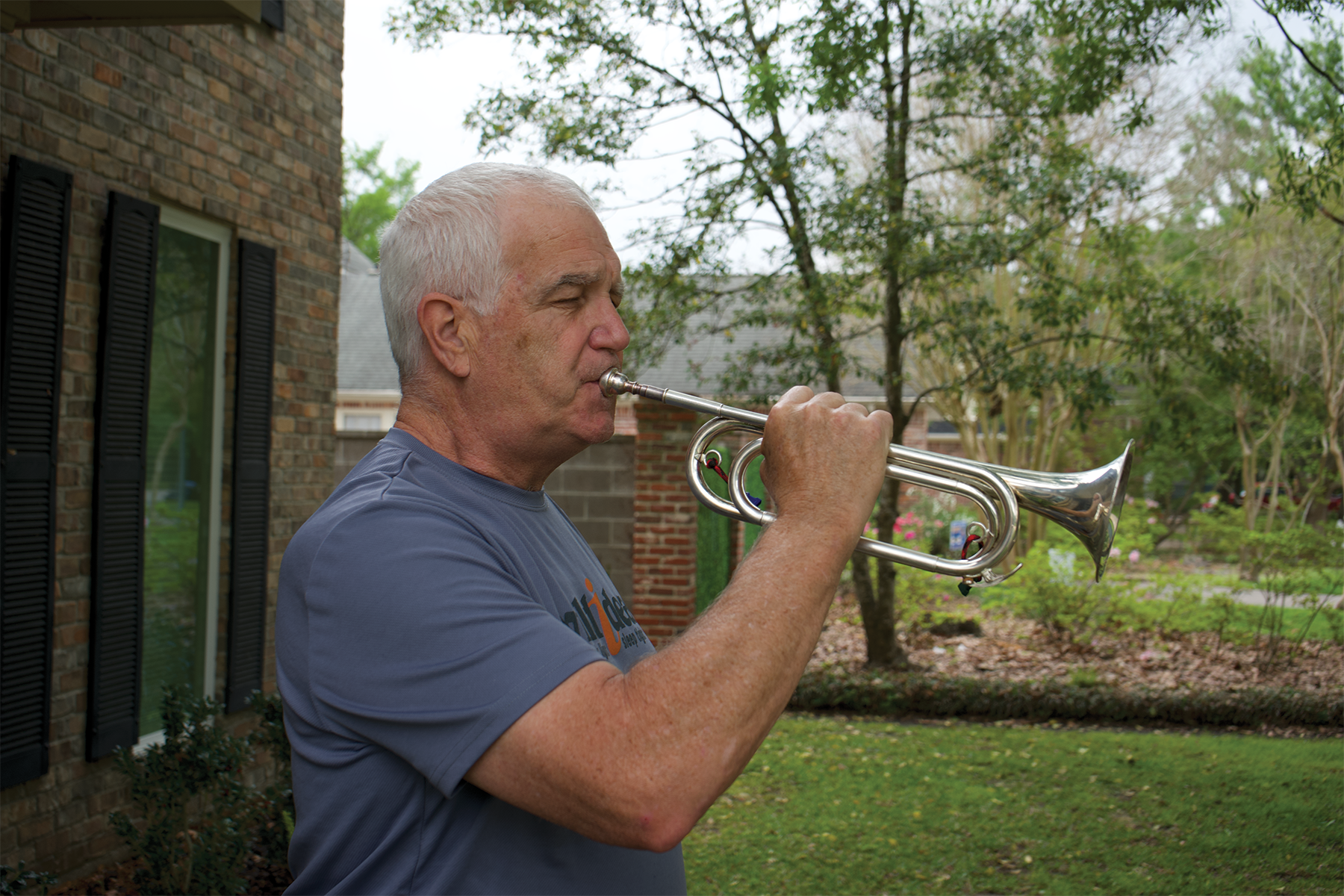
Donald Root plays a bugle donated by a family specifically for his Wounded Warrior Project effort. Those who wish to donate to the Wounded Warrior Project through Root’s cause may scan the QR code and follow the link

QR code.
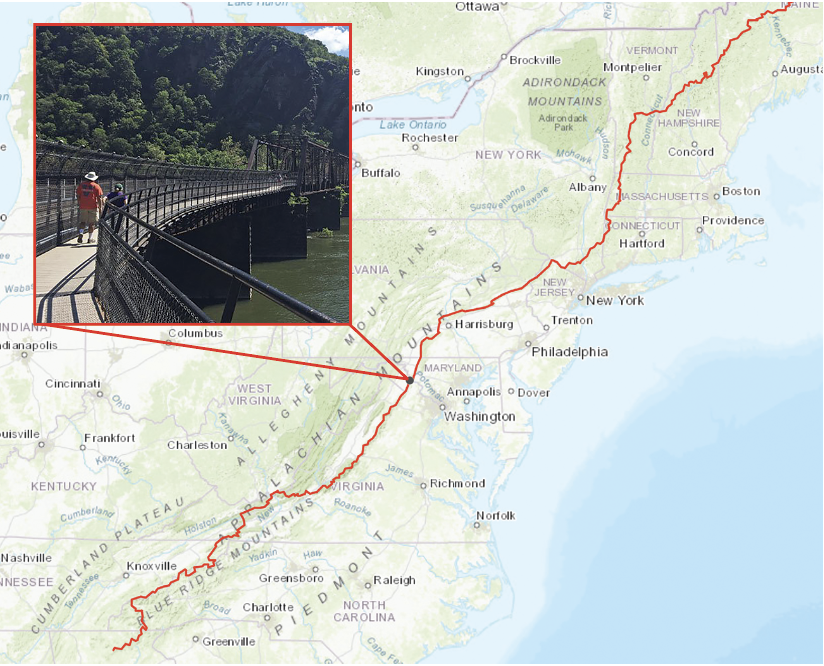
Root plans to begin his cross-country trek in Harpers Ferry, West Virginia near the Potomac River, shown here