

Community health centers are not for just the homeless, or people with HIV, or for just a particular population. I would love to get community health centers thought of differently: It’s not just for a particular population.
— Triangle Area Network (TAN) Healthcare CEO Dena Hughes
What was once known as a clinic only treating those with a specific need in Beaumont has now blossomed into a fully functioning health clinic that not only provides services to all of Beaumont – and Jefferson County – but also encapsulates the entirety of the Golden Triangle, as well as rural communities in counties to the north as far away at Pineland. What’s even better, Triangle Area Network (TAN) Healthcare CEO Dena Hughes detailed before a captive audience at the Feb. 16 meeting of the Press Club of Southeast Texas, is that much of the services can be provided free of charge to those without insurance, or who are underinsured.
As one of very few local clinics accepting patients otherwise turned away from network providers, or outpriced for the services, TAN’s roots are planted in being the place to turn to when traditional medical care isn’t available – or isn’t practical. In the 1987, TAN began as the Triangle AIDS Network, focusing care on those diagnosed with HIV and AIDS, attending to patient medical needs, securing funding for the same, and serving as a support for the community served by the care providers.
“It was the only organization in Southeast Texas that was supporting a particular population,” Hughes explained of the nonprofit entity that thrived for nearly three decades. Galas and grants supplanted the fiscal costs associated with being a medical facility that offered care regardless of ability to pay. Hundreds – if not thousands – were treated, were provided with life-extending medicines otherwise too costly to acquire, and were embraced by a board of directors committed to continuing the mission of care to those most in need.
Under new management
TAN’s presence in the community was a welcome staple supported by national and local grants, and private donors, before Peggy Gibson took charge of the health care facility. As CEO of the nonprofit, Gibson absconded with more than $300,000 of TAN funds, as revealed in the pages of this publication. The Examiner investigation and state prosecution prompted a shakeup at the organization that resulted in realignment of administration, as well as clientele, in 2012. Gibson received “shock probation,” a pittance of time behind bars, and has since been released. Gibson’s daughter, Amanda Coker, was also charged with theft from TAN for receiving and cashing unearned checks endorsed by her mom.
Reeling from the blow Gibson and her offspring blindsided to the bank account, in addition to the social scandal that ensued with donors distancing themselves from the sinking ship, TAN needed a miracle to stay afloat. In answer to prayer – and an ad for a new facility director – TAN welcomed Dena Hughes as interim leader in 2012.
Hughes’ first task at the helm of a health care center embroiled in embezzlement embarrassment was to rebuild trust – with the community, with the clients, with the providers, with the donors … Year after year, Hughes worked to prove that TAN was indeed the health care facility it was originally chartered to be.
Then, Hughes proved TAN could be even more. Noticing the lack of additional medical care for those receiving TAN’s services, Hughes sought to fill the gap in care available to those with limited means. In response, under Hughes’ leadership, TAN Healthcare qualified to become a Federally Qualified Health Center (FQHC) “that provides primary and preventive care in a consistent and affordable manner, improving the health of area communities.” A board-approved title change to CEO in June 2016 underscored the progress made under Hughes’ tutelage.
The changing landscape of health care that led TAN to transform from a niche HIV-service organization into a full-service health center, providing comprehensive and primary care services for all individuals in Southeast Texas, regardless of their ability to pay, also led to the nonprofit instituting added services, as well. Along with TAN’s location in Beaumont, an additional facility was opened in Orange, a mobile health unit was put into service to reach extremely rural areas, and behavioral health services were added to the care available from TAN providers.
“We did expand under the area concept to provide health care to anyone, regardless of what area they live in,” Hughes said, adding that TAN serves a multi-county area including Jefferson, Orange, Hardin, Jasper, Newton, Sabine and Tyler counties.
According to Hughes, there are just three community health care centers providing services to uninsured and underinsured patients in all of Southeast Texas – TAN, Legacy, and Gulf Coast.
Boldly go where no one goes
The TAN mobile health center provides primary care visits with copays starting at $25, with labs included. TAN providers also offer telehealth options, transportation, pediatrics and behavioral health services.
“We are rural health care providers,” Hughes said, which requires the health center to reach those is communities much smaller than cities like Beaumont and Orange, which are considered surburban for funding purposes. “If you want to get rural funding, you have to go to another part of the region to get funding.”
According to the RuralHealthInfo.org, Texas had 3.1 million people living in non-metro areas in 2020, with 328 rural health clinics, 208 FQHCs and 88 critical access hospitals. The data further reports 16.7% of Texas residents do not have health insurance.
“If you need medical care and have an insurance card, we’ll see you,” Hughes said. “If you don’t have insurance, we’ll see you.
“And, for individuals who don’t have health insurance or coverage, we have a relationship with the federal government at allocates a certain amount of dollars so those individuals can be seen and get the type of care an individual with the card can get.”
Hughes said the point and purpose of TAN is to provide medical care to the community, regardless of their situation. And, since TAN isn’t like traditional private providers and network facilities, TAN isn’t like traditional private providers and network facilities. At TAN, medical care is a personal experience, and the facility even offers staff to assist in navigating an individual through the process of acquiring care, prescription assistance or medication management.
“Some one has to be there to make sure to walk them through the process,” Hughes said, especially for patients who have had limited access to medical care in the past. “(Providers) have to be there to make sure that the things you need are met and your health care needs can be met.”
Hughes said TAN offers assistance for transportation to medical appointments, medications and medication management.
“It’s important for people who are uninsured,” she said. “If a person can’t afford a visit, a person can’t afford the medication. We have to make sure that we have the resources available to navigate prescription assistance.”
Getting to the provider to get a prescription seems to be one of the biggest barriers to wellness, Hughes explained, also detailing TAN’s method of addressing that need, too.
“It is an actual service to eliminate transportation gaps in care that truly exists,” she said, pointing to three vans used to transport individuals to and from their appointments.
With the health center providing transport, finding a way to fund prescriptions, offering top level care for any ailment that any other doctor’s office can treat, and striving to be a bridge between being sick and being a healthy, happy and functioning part of the community, TAN CEO Hughes can’t quite understand why anyone would go anywhere else.
Now taking appointments
“Community health centers are not for just the homeless, or people with HIV, or for just a particular population,” Hughes explained. “I would love to get community health centers thought of differently: It’s not just for a particular population.”
Uninsured, or underinsured, “the community health centers are a perfect opportunity to get your needs met,” Hughes said. Insured clients benefit, as well. According to Hughes, many TAN staffers are also TAN clients, herself included.
“Why would I go anywhere else?” Hughes balked “It doesn’t make any sense. I love my providers!”
Hughes said has funds available for specialty care, such as mammograms, pap smears, CAT scans and MRIs.
“We try to use those dollars to get those patients to the next level, if they are uninsured,” she said, adding that there are also dollars set aside to provide pediatric care, and behavior health services.
“We have a psychiatrist, two psychiatric nurse practitioners and counselors,” Hughes detailed. “If it is a chemical behavior health concern or emotional behavior health concern, we have the ability to support the community in that way. We know how critical behavioral health services are.”
According to Hughes, TAN is a $7 million organization with 60 employees. She added that TAN is planning the return of the “Paint the Town Red” event and other additional fundraising events.
“It does require the community to support TAN,” Hughes said, although even a little goes far. “Twenty-five dollars can provide care for four adult people for labs and access to medication.”
Health care center hours are 7 a.m.– 6 p.m. on Monday; 8 a.m. – 5 p.m. on Tuesday, Wednesday and Thursday; and 8 a.m. – 3 p.m. on Friday.
The mobile unit currently makes planned visits to the Heath Department in Kountze and New Life Church in Batson for Hardin County residents, and also has stops planned at the Stringer Building in Kirbyville for Jasper County patients and at the Servant United Methodist Church in Newton for Newton County patients.
Sabine County patients can go to the mobile clinic at the Pineland Housing Authority in Pineland and Tyler County patients can go to the First Baptist Church in Hillister.
Orange County patients can go to the 5K Ministries Food Pantry in Mauriceville.
TAN accepts most commercial insurance, as well as Medicare and Medicaid. All insured patients are required to pay their regular copay, however, a sliding scale fee copay is based on income and household size.
Appointments can be made from 8 a.m. to 3 p.m. and for dates, visit www.tanhealthcare.org. New patients can call (409) 550-1067 or go online to register.

TAN Healthcare CEO Dena Hughes
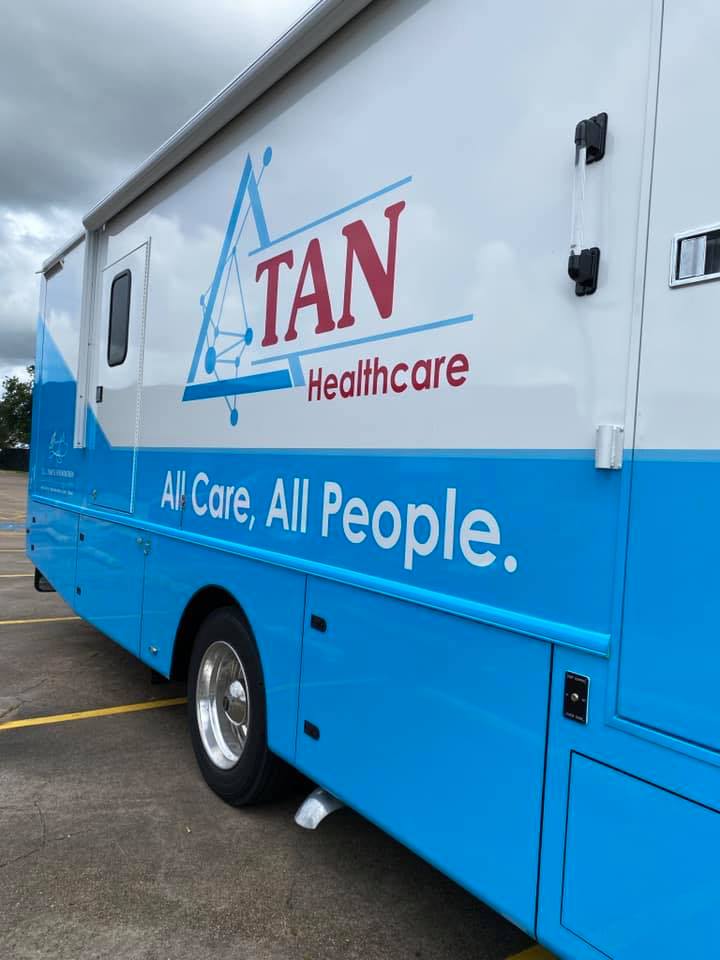
TAN Healthcare Mobile Unit
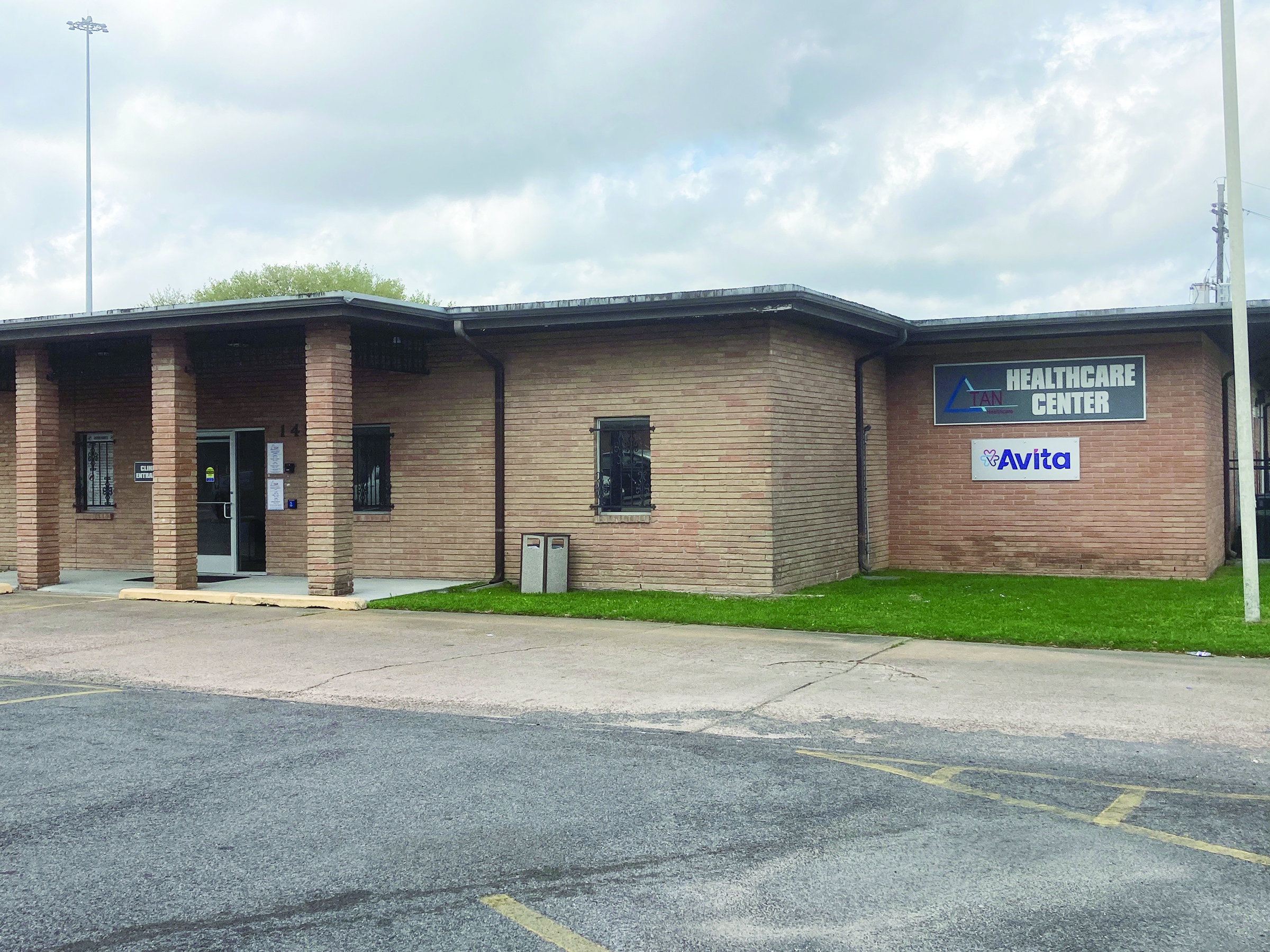
TAN Healthcare Building on Seventh Street in Beaumont