

Shrinking reserves, rising costs shape Beaumont’s budget discussion
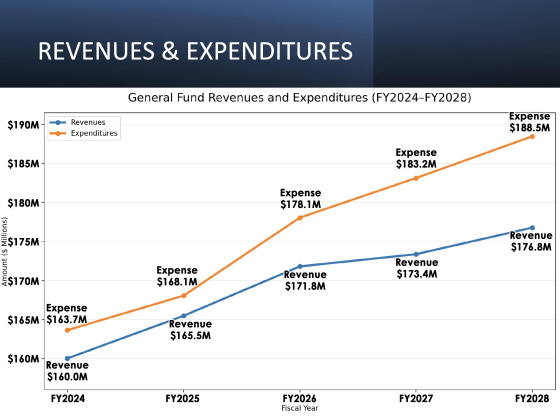
Beaumont officials got their first detailed look at the city’s Fiscal Year 2027 (FY27) budget Wednesday, with the numbers raising concerns regarding declining reserves, rising personnel costs and a growing gap between revenues and expenses.
During the city’s second budget workshop June 3, City Manager Chris Boone delivered a sobering assessment of Beaumont’s financial outlook just one month after taking office.
Boone noted that, for the past four years, the city has relied on its general fund balance, which is often referred to as a rainy-day fund, to cover the gap between spending and revenues.
According to Boone, Beaumont’s fund balance has fallen from $53.5 million in FY22 to a projected $35.2 million by the end of FY26, a decline of more than $18.3 million, or approximately 34%. Boone previously told The Examiner that upward of $10 million of reserve funding was depleted in the last year alone.
The Government Finance Officers Association recommends municipalities maintain at least two months of operating expenses in reserve, roughly 16.5% of annual expenditures. Beaumont’s own policy requires a 20% reserve.
“Because expenditures have outpaced revenue since 2022, we have continued to dip into our fund balance,” Boone said. “We expect our fund balance to be at or below 20% within 90 days.”
He warned that, if current trends continue, reserves could fall below the recommended minimum during FY27 and reach as low as 7% by FY28.
“I point this out not to be (an) alarmist, but to stress that we need to reduce our expenses and certainly not increase them. This year, next year and beyond,” Boone emphasized, further reporting that personnel costs represent approximately 71% to 72% of the city’s general fund budget, limiting flexibility.
“Apart from our fund balance, which is a key metric, the simple fact is that our revenues are not growing as fast as our expenses,” Boone said. “Even if we hold our expense levels at the current budget year FY26 levels, we would have to hold them there until 2029 for the revenues to catch up at the current pace.”
Budget Manager Amy Schmidt followed Boone’s presentation with a detailed review of the city’s finances.
Schmidt revealed that city staffing has steadily increased from 1,329 employees in FY23 to 1,447 budgeted employees in FY26. Schmidt noted that, beginning in FY25, staffing totals also included part-time and grant-funded positions.
“Our revenues are not growing at the same rate of our expenses, which causes the decline in the fund balance,” Schmidt agreed. “By FY 27, we will be below the minimum.”
Schmidt said the department has analyzed the impact of a hiring freeze to potentially provide relief to the budget.
“For FY27, if we did a hiring freeze, that would approximately save about $3.7 million …if we did not fill any current vacancies,” Schmidt said, adding that, even under that scenario, reserve levels would only improve to 16% in FY27 and 11% in FY28. Schmidt clarified the hiring freeze would apply only to civilian positions and not public safety personnel.
Despite budget pressures, revenue projections have slightly exceeded expectations. The FY26 budget anticipated $169.7 million in revenue, while current projections show approximately $171.8 million.
“Sales tax came in a little bit higher; we had higher industrial payments that we weren’t anticipating,” Schmidt said.
Several council members pressed staff for answers about how the city arrived at its current financial position. Council member Cory Crenshaw pointed to previous budget discussions where officials had projected a much smaller deficit.
After asking about the final FY26 deficit, Schmidt reported it currently stands at approximately $4.5 million. She cited unexpected increases in transfers to the employee benefits fund and transit operations. Among the most significant cost drivers, she added, are labor agreements with police and fire unions, rising pension obligations and overtime costs.
The fire department received wage increases of 7% in FY25, 4% in FY26 and is scheduled for another 3% increase in FY27. Police officers received increases of 3% in FY25, 4% in FY26 and will receive 5% in FY27.
Council members also examined the city’s investment portfolio. Chief Financial Officer Bridgett Evick said Beaumont currently has more than $100 million invested across various funds.
Crenshaw questioned the returns being generated, noting the city projected $1.9 million in investment revenue for FY26 but is currently expected to receive about $1.8 million.
“That seems a little underwhelming. We need to take a look at that,” Crenshaw said.
Boone responded that state laws limit some investment options available to government entities but agreed staff could provide a detailed review.
The discussion also highlighted growing overtime expenses, particularly within the fire department.
It was revealed that police overtime was budgeted at $2.6 million but is projected to reach $2.9 million, a number council noted as acceptable. Fire department overtime presents an even larger challenge, with expenditures projected at $5.5 million compared to a budget of $2.8 million.
Council member AJ Turner requested a five-year analysis of trends to better understand the city’s long-term outlook.
As council members entertained potential solutions, Evick discussed early-stage conversations about alternative health care options for employees, including partnerships with standalone medical facilities to help control rising health care costs.
Crenshaw also questioned administration’s proposals to eliminate city-sponsored events while exploring budget reductions.
“We’re talking about eliminating city-sponsored events,” Crenshaw balked. “These are quality of life events. Why don’t we do another tax note to get this budget actually balanced?”
Boone pushed back on the idea of borrowing to cover operating expenses.
“If you know all your expenses are ‘x’ and your income is ‘y,’ you don’t want to kept taking out loans to cover operating expenses,” Boone said.
Public safety budgets under scrutiny
Much of the workshop focused on public safety spending, which accounts for the majority of general fund expenditures.
Fire Chief Earl White told council members the department expects overtime costs to decrease as staffing improves. White noted that the department currently has seven recruits in the academy and plans to begin training five additional hires soon.
“A little impact this fiscal year and a lot next fiscal year,” is anticipated, White said. “We process 15 (firefighters) in hopes of getting 5.”
White has said before that the low completion rate contributes greatly to cost. Although firefighters currently in the academy would fully staff the department, White noted that approximately seven to eight retirements are expected in October.
Crenshaw acknowledged the department’s efforts but voiced frustration over years of escalating overtime expenses.
“I feel like I’m having a bit of deja vu here,” Crenshaw said. “It seems like when I first started paying attention to the firefighter overtime budget in January 2025, we had a presentation from Chief White then…talking about numbers getting better, but here we are in 2026, and the numbers are still awful.
“It’s year, after year, after year of these huge overtime numbers…I hope next year at budget we see the savings. I don’t understand why it took four years of doubling our overtime budget. I feel like I’d be remiss if I didn’t say ‘Great, we have some projected overtime saving analysis,’ but taxpayers are very concerned it took us this long to get here.”
White responded that the department had been negotiating with the firefighters union and had worked to improve academy pass rates by providing additional support to recruits.
Crenshaw concluded the exchange:
“I’m gonna hope and pray that our projected overtime savings analysis turns out to be accurate, but this time next year, chief, if we’re at $5.5 million in overtime for the fire department, its gonna be unacceptable and I will personally have to demand change from the city manager because enough is enough.”
Police Chief Tim Ocnaschek presented a more optimistic picture.
He said approximately $300,000 in reimbursements should bring police overtime spending back within budget by year-end. The department currently has 15 vacancies, but six cadets are scheduled to graduate from the police academy next week.
Ocnaschek also highlighted $3.6 million in grant requests, of which the department has already secured $1.7 million.
“Y’all approved a good contract last year. The police have a competitive contract now. With signing incentives, it is helping us be more attractive to pull from other agencies and we believe that is going to help,” Ocnaschek said.
He credited technology investments, including the Real Time Crime Center, with improving efficiency and reducing crime.
“The technology is helping stretch manpower. Taking the administrative work off of them helps us get them back on the street faster,” he said.
According to Ocnaschek, violent crime and property crime have both experienced significant declines. Since the crime center’s inception, auto thefts have fallen 43%, while ATM and catalytic converter thefts have also dropped substantially.
“People became a little more reluctant to come over here from Houston to steal ATMs and catalytic converters when they were getting caught before getting back to Houston,” Ocnaschek said.
The chief reported that more than 4,000 cameras have been registered with the city’s camera-sharing network, assisting in more than 700 criminal investigations.
City officials will continue refining budget projections throughout the summer before presenting a proposed FY27 budget. Another budget workshop is scheduled for July 15.
Beaumont’s new fiscal year begins Oct. 1, with council expected to formally adopt the FY27 budget in mid-September.
Courtesy Image