

.
After two years of delays caused by lawsuits, the Texas Education Agency (TEA) released the 2025 A – F district accountability ratings Aug. 15, along with the previously withheld 2024 scores. The release marked what TEA Commissioner Mike Morath described as “a return to clarity and accountability” for families, communities, and educators across the state.
Of the 1,208 districts and 9,084 campuses rated this year, 24% of districts and 31% of campuses improved their letter grade from 2024. While most maintained the same rating, only 15% saw a decline. The agency highlighted that 43% of high-poverty campuses statewide earned an A or B rating, underscoring that “demographics do not equal destiny.”
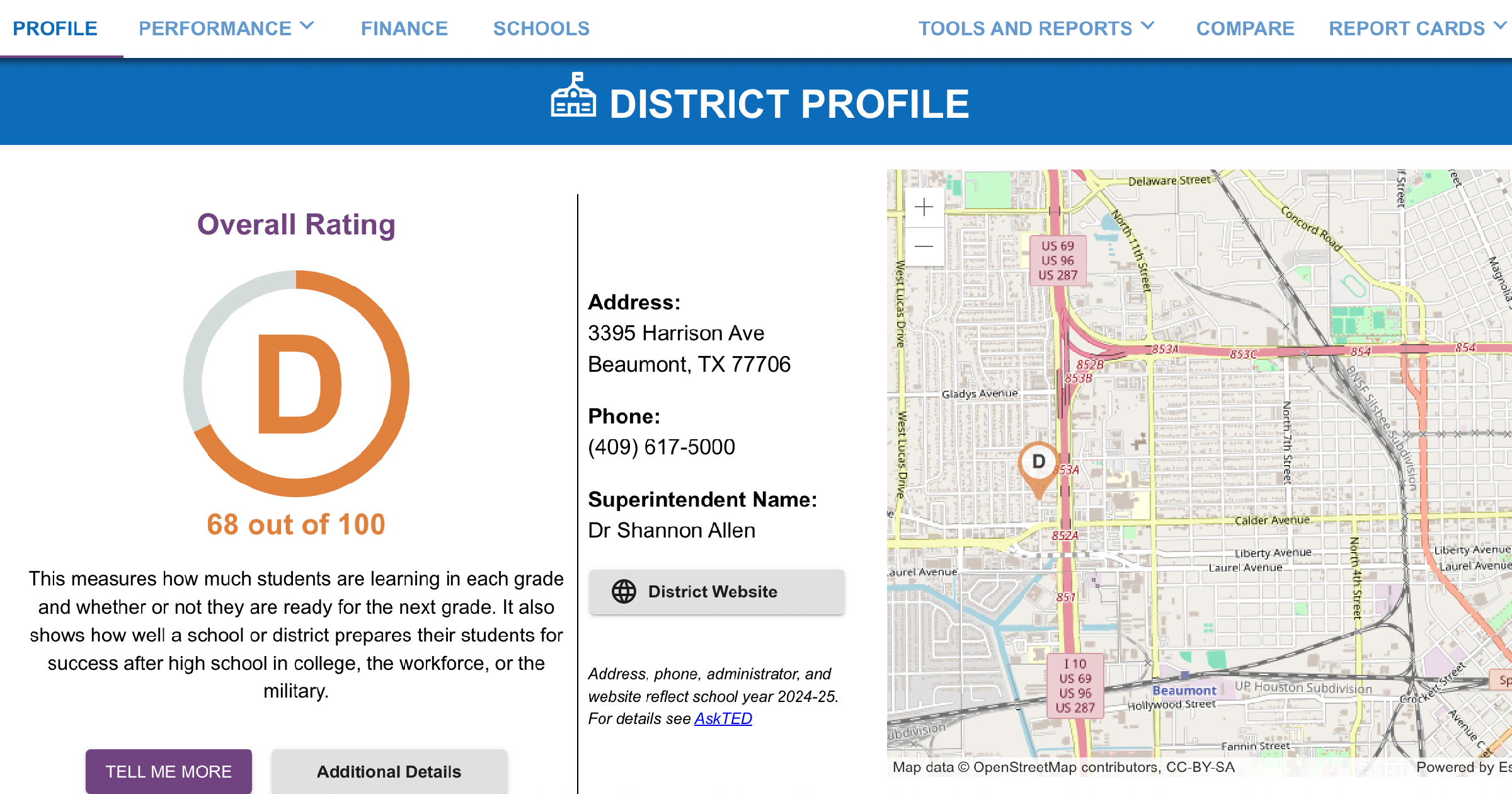
In Beaumont, the numbers reflected little movement. Beaumont ISD earned an overall D rating with a score of 68 for the 2024-25 school year, up slightly from a 65 the year before. The district scored a 66 in both 2022-23 and 2021-22. Due to Senate Bill 1365, BISD was listed as “Not Rated” in 2021-22 despite earning a D, and all Texas districts went unrated in 2019-20 under COVID-19 disaster declarations.
The consistency of BISD’s marks has raised questions about progress, but Superintendent Dr. Shannon Allen said the district is investing in new approaches.
“We are in the process of implementing a new math curriculum for PK–5th called Bluebonnet,” Allen said. “We have trained our teachers, have received positive feedback and they are exceptionally excited. I’m happy to see the investment already from our teachers. I feel like that is going to give us a huge jump in our math performance this year.”
In an interview with The Examiner, Allen reflected on the possibility that even total improvement may not be enough to stave off state intervention at this point – but added that she is adamant in her pursuit to prove BISD’s viability.
Campus-by-campus breakdown
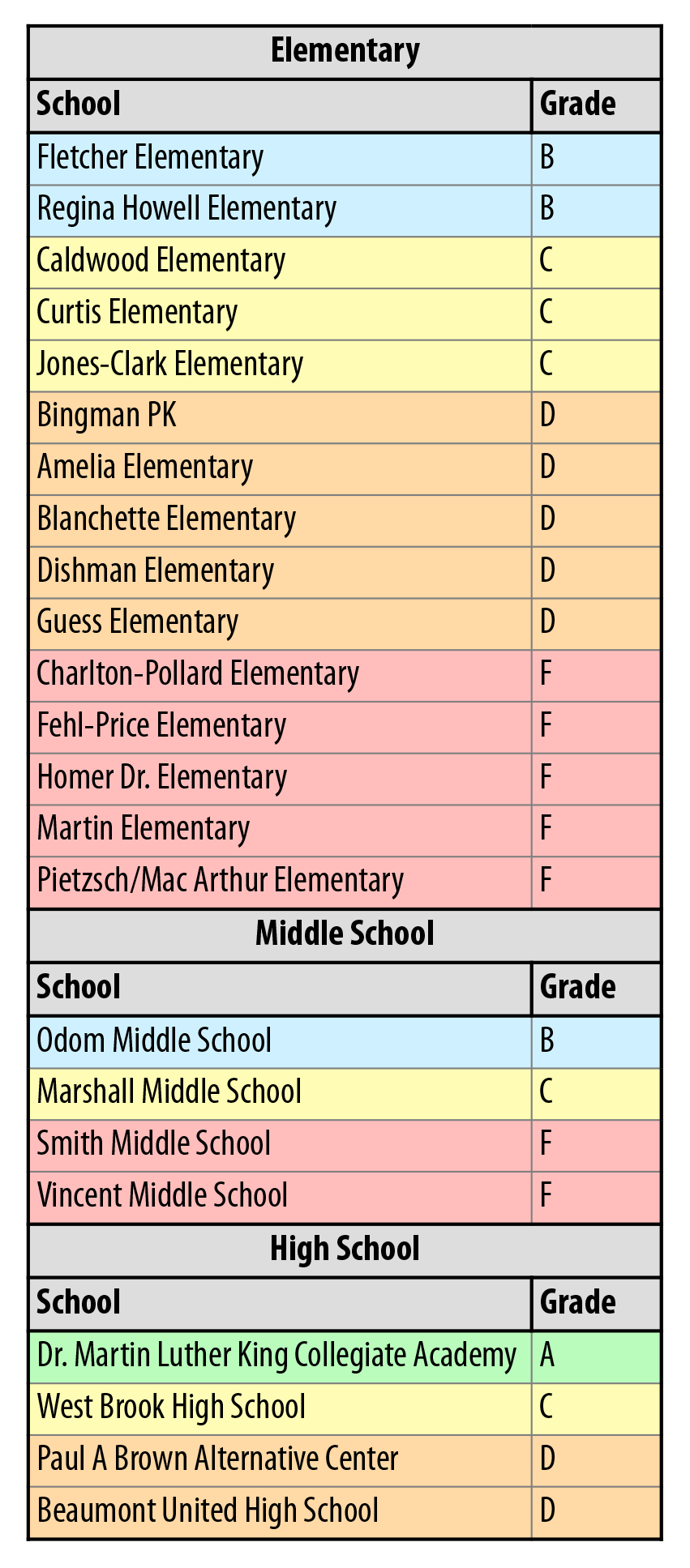
BISD operates 26 campuses and serves 16,315 students. Ratings for the 2024-25 school year span the full spectrum of TEA’s accountability system:
• A rating: Dr. Martin Luther King Collegiate Academy (called King Collegiate, formerly named Beaumont Early College, Grades 9–12)
• B ratings: Fletcher Elementary, Odom Middle School, Regina Howell Elementary
• C ratings: Caldwood Elementary, Curtis Elementary, Dr. Mae E. Jones-Clark Elementary, Marshall Middle School, West Brook Sr. High School
• D ratings: Amelia Elementary, Bingman Pre-K, Blanchette Elementary, Dishman Elementary, Guess Elementary, Beaumont United High School, Paul A. Brown Alternative Center
• F ratings: Charlton-Pollard Elementary, Fehl-Price Elementary, Homer Dr. Elementary, Martin Elementary, Pietzsch/MacArthur Elementary, Smith Middle School, Vincent Middle School
While poverty is often credited as directly correlating with low performance, BISD data showed outliers. Fletcher Elementary, with 97.1% of students economically disadvantaged, earned the district’s highest elementary score, a B (84). King Collegiate, the district’s only A-rated campus, is similarly composed of an economically disadvantaged population.
Chronic absenteeism appears to play a more decisive role. Fletcher and Regina Howell, the two highest-rated elementary schools, reported the lowest absenteeism rates in the district. Fehl-Price Elementary, which earned an F (59), recorded the highest chronic absenteeism rate at 54.2%.
Class size and teacher stability also emerged as possible correlating factors. Fletcher had the district’s smallest student-teacher ratio at 14.5, while Caldwood Elementary had the largest at 18.9 — but Caldwood still managed a C (75). Meanwhile, Pietzsch/MacArthur Elementary had just 16.6 students per teacher, yet earned the lowest overall score of 45. Teacher experience stood out: at Fletcher, 48.5% of staff had 11 – 30 years of experience.
According to Allen, the district has not been notified of a possible TEA takeover despite Pietzsch/MacArthur Elementary’s repeated D/F ratings since 2019. At first glance, it seems pandemic-related and disaster-related “Not Rated” years disrupted the pattern of consecutive failing grades that can trigger state intervention. However, Allen learned Aug. 18 – through local media rather than Morath himself – that the district may be at risk of TEA takeover. Allen was able to speak with Morath briefly Aug. 19, and was advised it would be months before a decision would be made.
“I read his comments … I’m appalled … frustrated. I sent the commissioner a letter before the ratings and the scores came out … I had some issues and concerns … and wanted to give him my perspective and hear his perspective. I sent the letter Aug. 7 and didn’t hear anything, which is unusual,” Allen reflected on an email she thought to be of urgent interest. BISD’s superintendent thought so much of speaking with the TEA commissioner that she said she then resent the email to Morath and, before receiving a response, heard Morath made comments regarding BISD to the media while at an appearance just 30 miles down the road in Evadale.
Tuesday morning, Aug. 19, Allen said she received a call from Morath who, according to Allen told her, “I know the work that is going on in Beaumont ISD; I am not in any hurry or any rush to make a decision.”
Despite the possible uprooting of the local school district hanging in the wind indefinitely, Allen said her focus is not a school take-over or closing schools. Instead, she said, her concentration remains on the students under her charge, and going “all in, all year” for them.
Still, there is much work to do at the district level now that the TEA scores have been finalized. According to Allen, individual campuses are required to write a target improvement plan or turnaround plan based on the performance of an individual campus.
“We recently had a couple plans approved by our board, but we are required to write a turnaround plan based on the performance of struggling campuses,” Allen explained.
Allen said one of the district’s biggest hurdles is keeping experienced teachers at campuses most in need.
“When you go to really start to dig deep into the analysis of the data, several of our campuses struggling have a hard time recruiting and retaining teachers,” she said. “Oftentimes, campuses with higher percentage of poverty struggle more, need more, and it’s hard to retain teachers. At Fletcher, they have been able to retain a veteran high-quality staff, where, at some of our other campuses that struggle, it’s been harder to maintain that.”
To address the problem, BISD is applying for the Teacher Incentive Allotment, a state program that offers up to $30,000 annually to educators working at high-poverty schools.
“We’re in the process of applying for the teacher incentive allotment and I’m hoping that will be effective in the future with being able to recruit and retain teachers,” Allen said.
The district has also implemented smaller incentives, including the YMBL-BISD Fair Day partnership, which rewards students for improved attendance.
Allen emphasized that attendance remains a major barrier to student performance.
“We know the correlation between student success is greatly contingent on them being present in a learning environment every single day. We still have not recovered to pre-COVID levels of attendance,” she said. “We try to encourage parents and families to be in school. Of course, with laws changing, it makes it more difficult to maintain accountability for students coming to school. That impacted many communities in a way that was not positive for students.”
Allen said she remains cautiously optimistic, though. The district’s “D” rating underscores how far Beaumont ISD has to go, she admitted, but Allen said the numbers also serve as a call to action for educators, parents, and the community. With attendance, teacher retention, and curriculum changes at the forefront, Allen emphasized that improvement will require shared responsibility and continued investment from across the city.
Comparing apples and oranges
Across Region 5, which covers 33 districts and 6 charter systems in Southeast Texas serving 90,000 students, BISD ranked near the bottom with its score of 68.
Charters are tuition-free and open to all students, but enrollment is capped. When demand exceeds available seats, students are selected through a lottery system allegedly required to be fair and nondiscriminatory.
Public charter schools in Jefferson County generally fared better than BISD. Ehrhart School (PK–9), Ignite Community School (PK–6), and Evolution Academy Charter School (9–12) all received A ratings. Bob Hope School (PK–8) and Harmony Science Academy (PK–12) each earned B ratings. Tekoa Academy was rated among the poorest campuses, with a grade of just 59 – an F. Based in Port Arthur, the public charter reported 419 students, 91% economically disadvantaged.
Top-performing public school districts in Southeast Texas included Nederland ISD and Chester ISD (B, 88), followed by Brookeland (87), Sabine Pass (86), Evadale (85), East Chambers (84), Hardin-Jefferson (84), Port Neches-Groves (83), Hamshire-Fannett (83), High Island (82), Orangefield (82), and Vidor (80).
At the bottom were Burkeville ISD (F, 57), Hull-Daisetta (59), Port Arthur (64), Colmesneil (66), Buna (67), Woodville (67), Beaumont (68), West Orange-Cove (68), Silsbee (69), and Jasper (69). Above the below and below the upper was Lumberton ISD, posting a C (77) rating with only its high school campus earning a B.

.
.