

At the March 25 Beaumont City Council meeting, members debated the city’s financial policies, ultimately voting to change the definition of a “balanced budget.” The revision, which eliminates consideration for utilizing reserve funds in balancing the budget, was met with mixed reactions from city officials and council members.
Duncan Brown Jr., the city’s assistant chief financial officer, presented an overview of the financial policies and budget challenges. Brown referenced recommendations from the Government Finance Officers Association, stating that governments should maintain a structurally balanced budget where recurring revenues are equal to or greater than recurring expenditures.
Brown highlighted the challenges in ensuring expenses remain below revenue, particularly when considering capital equipment purchases such as fire trucks, ambulances, police vehicles, legal claims and grant matches. Often, expenses planned in one fiscal year occur in another, causing a misalignment of funds.
Historically, the city’s financial policy stated that total proposed expenditures should not exceed total anticipated revenues in the city manager’s proposed budget. This year, however, the financial policy allowed for expenditures to exceed revenues considering available reserves above the required threshold of a 2018-instituted reserve level at 20% of annual expenditures.
Councilman Mike Getz inquired about past budgeting practices, to which Brown responded:
“At least since 2010, this council has approved and adopted a budget where the total expenditures exceeded anticipated revenues … every year.”
The discussion raised concerns about maintaining fiscal responsibility, while also addressing the city’s needs. City Manager Kenneth Williams noted that the reserve functions as a safeguard against unexpected financial risks.
Council members debated the urgency of addressing the reserve balance. Councilman Audwin Samuel voiced concerns about the timing of the discussion, stating: “We’re trying to move our city ahead, to increase our population …
“We had an opportunity to do this any other time prior to budget, but we wait until a time like this, right before elections… If you had concerns and you throw out ‘budget deficit,’ that’s alarming to some people, and it gives people doubt.”
Others, including Councilman Taylor Neild, pointed out that the fund balance is lower than it was in 2019, raising questions about long-term financial sustainability. Timing, as members pointed out, coincides with the fact that the elected group is currently in the process of preparing next year’s budget, which goes into effect in October. Councilman Randy Feldschau echoed concerns of the fiscally conservative, noting a trend of depleting funds in the general fund balance, stating:
“If I spend more in the year than what I took in, and I have to take money out of my savings as a one-time deal in a bad year, it’s okay… but if I do that every year for 10 years, I’m going to break myself financially.”
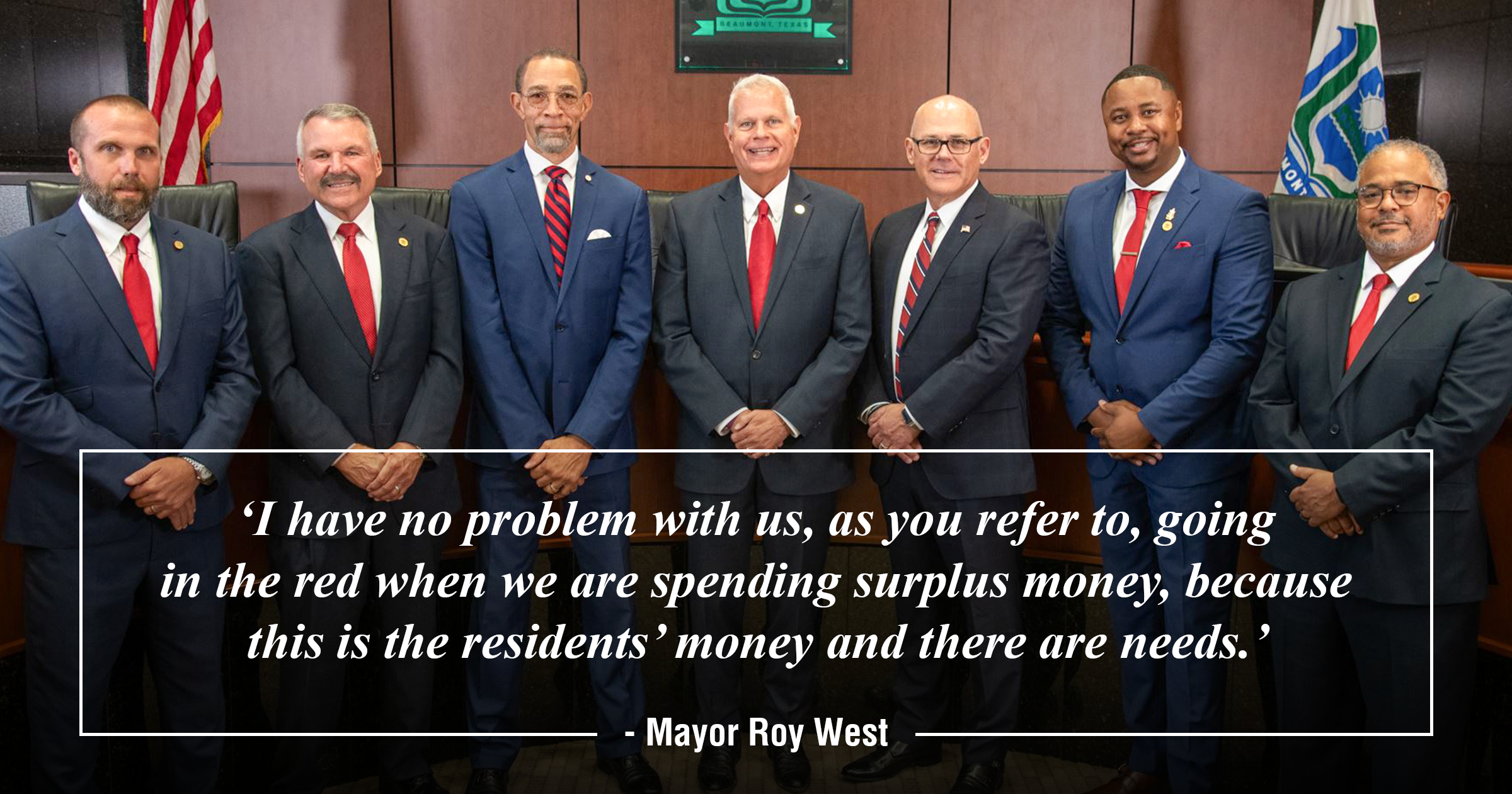
Mayor Roy West, however, dismissed fears of financial instability, arguing that spending surplus funds is a necessary function of governance:
“I have no problem with us, as you refer to, going in the red when we are spending surplus money, because this is the residents’ money and there are needs.”
According to West, not spending the taxpayers’ money “is a slap in the face.” The mayor said spending the money was “giving back” to the citizens, despite stated citizen concerns of higher city tax bills, higher water and sewer bills and recently engorged municipal and rental fees driving up the alleged “surplus.”
Following the discussion, city council unanimously approved a new definition for a balanced budget: “A balanced budget represents recurring revenues that are greater than or equal to recurring expenditures in the adopted budget.” This change eliminates the previous policy that allowed available reserves above the 20% threshold to be factored into budget balancing.
With the new policy in place, city officials must ensure that ongoing expenditures align with recurring revenues without relying on reserves, marking a shift in Beaumont’s approach to fiscal management.
As the city prepares to begin the budget for fiscal year 2026, it is notable that, as of March 11, the city of Beaumont does not have a Chief Financial Officer (CFO). Following the resignation of CFO Cheryl Ray on Jan. 3, the city chose not to appoint an interim CFO. Instead, the responsibilities have been distributed among existing staff: Assistant City Manager June Ellis, Assistant Chief Financial Officer Duncan Brown Jr., and Deputy Controller and Certified Public Accountant, Bridgette Evick, while the city searches for a permanent CFO.
According to Williams, the first budget workshop is planned for May as the city anticipates the creation of the FY2026 budget. Still, as revealed in discussion during the March 25 meeting, current budget drafts already encumber money to be raised through a proposed bond initiative. How much the city wants is yet undetermined, as is for what the money will be used. City council approved hiring Gap Strategies on Feb. 18 to conduct a $152,977 bond feasibility study analyzing potential projects and voted to establish a Bond Advisory Committee and approve a FY25 budget amendment to fund the study. The budget amendment passed despite Feldschau abstaining and opposition from Getz and Neild.
Getz said the process is moving to too fast in an effort to allow for submission on a November ballot but, with money from the bond already earmarked for FY2026, the recommendation from staff was to push forward with the short deadline.
“I feel like we’re trying to shoehorn too much in, too fast,” Getz said. “It’s been 42 years since we had a bond. We’ve just been told we’re already behind schedule. We don’t even know what this bond is going to contain.
“So, I don’t see, realistically, that it’s a great idea to try to compress and force all of this in for a November election. That’s why I voted against hiring Gap Strategies before. And, I’m not going to support a budget amendment to pay them.”
Neild proposed a modification to the original resolution establishing the Bond Advisory Committee, ensuring it aligned with existing city ordinances and requiring committee members to be Beaumont residents – a change the council unanimously supported even though certain potential members have already been contacted, it was revealed at the council meeting.
According to Williams, law now requires bond initiatives to be specific in detailing for what the funds will be used.
“We don’t have a list,” of specific projects, as of yet, Williams said, adding that, before going to voters, the specifics will be determined. Williams said he is not advocating for the bond, personally, but does see the advantage in preparing now for any potential bond initiative, “I don't think there’s a timeline but, if you if you’re going to get a good comprehensive bond initiative, you’ve got to get started.”
.