

National legislative decisions exacted in recent weeks and days are taking food from the very mouths the national government claims to protect and serve, as budget cuts and the Big Beautiful Bill threaten the supplemental food provided to those in desperate need of the assistance, according to those tasked with feeding America – and Southeast Texans.
In an exclusive interview with Southeast Texas Food Bank President and CEO Harvey Zernial, The Examiner learned exactly what’s at stake.
Currently, the SETX Food Bank serves 2,803 senior citizens monthly just within its Commodities Supplemental Food Program across eight counties. This program — often referred to as “Senior Food Boxes” — is only funded through September.
“The future of this program will be decided Oct. 1, if funding has not been allocated at that point,” said Zernial. “Re-creation of the senior box program is something he (President Donald Trump) has mentioned wanting to do, with mention of creating a Make America Healthy Again (MAHA) box. He doesn’t feel like the box is as healthy as it should be and that it should be delivered directly to citizens; 73,000 seniors state wide will be impacted.”
That uncertainty is just the beginning. The Big Beautiful Bill (BBB), signed into law July 4, includes sweeping changes to federal food and health programs — including nearly $500 million in cuts to The Emergency Food Assistance Program (TEFAP). The loss with TEFAP budget cuts outside of the BBB alone eliminated 900,000 pounds of food from the SETX Food Bank’s 12-million-pound annual distribution.
“What we know today is there have been a few programs within TEFAP eliminated, which were extension programs eliminated through budget changes,” said Zernial, pointing to the ripple effect of the cuts that hits home hard. “The challenges faced are deciding to serve less families or serve the same number of families and provide less food per family.
“These are supplemental programs, not meant to provide 100% of the needs, but the need for assistance is increasing.”
Need for supplemental food supply is occurring at a time when grocery prices remain stubbornly high, as Zernial noted, in that, “Grocery prices have not dropped as expected, and typically drop with the cost of fuel – but we’ve yet to see that.”
Compounding the challenge, the Food Bank’s three primary sources of food — one-third from federal programs, one-third donated, and one-third purchased — are now under pressure.
“People tend to think food bank food is free,” Zernial shared. “Government-funded food is one-third of the food we get; one-third is donated, and one-third is purchased. If we want to give proteins, better qualities of food ... it has to be purchased, and that money comes from industry, donations, and the generosity of our community partners — more than $2 million a year."
Zernial also pointed to the sharp, local consequences of the nearly $200 billion in nationwide SNAP cuts outlined in the Big Beautiful Bill.
“When you look at SNAP and they cut almost 200 billion dollars, it’s impacting a lot of people,” he said. “We’ve learned that these cuts are not all immediate and will be spread over 8 years. Some of the demands being put on recipients to collect benefits will eliminate recipients. Of course, some of the criteria added is a positive thing, but the added consequences mean more people relying on food pantries for assistance.”
The local impact includes not only more clients needing help, but fewer resources to offer them, as the SNAP education program funding has also been cut. “If we lose our nutritionists who are crucial in teaching local nutrition and food habits, we are going to lose something that is essential at the roots of our mission.”
This program provides monthly classes across all age groups.
“The education programs teach people from 5 years old up to senior citizens,” Zernial detailed. “Classes are provided at schools, housing complexes, public locations — teaching healthy nutritious eating habits and how to prepare foods often shied away from for lack of knowing how to prepare them.”
Health and nutrition are inseparable, Zernial warned.
“Health care and proper nutrition go hand-in-hand and these cuts to both of them are going to impact SETX and the nation’s most vulnerable food insecure population,” he said. “Medicaid cuts may not directly impact us immediately, but if you do away with health care funding, they are having to use their food funding for health care needs, creating a larger population of people experiencing food insecurity.”
According to Feeding America, Southeast Texas ranks as the 11th worst food insecure region in the nation, with 19.6% of its total population affected. For seniors, that number jumps to 26.1%. Children fare even worse — 29.8% of children across the eight-county region live with food insecurity, making the region the worst in the nation.
“That is almost 1 in 3 of our children (who) go without three nutritious meals per day, especially in the summer,” Zernial noted. During the school year, the SETX Food Bank supports weekend nutrition through its Backpack Program. “It is done through the school year and SETX Food Bank provides about 100,000 backpacks per year and 20,000 in the summer — this includes summer schools, some housing complexes, church camps, about 25 sites through the area.”
As schools and local nonprofits have taken on the weekdays for ensuring students have adequate meals, the Backpack Program fills in the gaps on the weekends. This program is 100% funded by SETX Food Bank donations. Food distribution across the region is supported through an extensive agency network.
“Monthly, through the TEFAP foods through the agency networks, approximately 19,000 households — 45,000 individuals – are served monthly, within eight counties that have an approximate population of 540,000. Adding other monthly programs, 85,000 individuals are served monthly through SETX Food Bank,” said Zernial.
Even with a strong base of 2,000 volunteers and generous corporate partners like H-E-B, rising demand and shrinking resources are colliding.
“We appreciate our donors but, naturally, we are seeing donations slow down as people are at somewhat of a hold waiting to see how they are going to be impacted,” the food bank leader dismayed. “Most of the financial impact will be seen in 2027–2028, but our supporters cannot wait ’til then to prepare. I have no doubt that our partners will figure it out and come through like they always have.”
Zernial stressed that new solutions are underway, such as an expanding food rescue program.
“Retailers throw away millions of dollars of food annually for various reasons — package changing, dented cans, too much time on the shelves. We are trying to rescue and distribute most of that,” he said, adding that, last year, the food bank rescued 1.2 million pounds. This year, they’re on track to more than double that. “This program is costly to go pick everything up. We changed our model because Feeding America allowed us to."
The Food Bank’s eight platinum-tier agencies, including Market to Hope in Beaumont — which alone distributes 900,000 pounds of food annually to 1,600 families monthly — are mostly faith-based and essential to the new, expanded model, Zernial said. But, with increasing pressure on all fronts, hard decisions are coming.
“The impact of all these cuts go hand-in-hand because, if I have to make adjustments with SNAP or any other program, it is going to eventually impact our other programs such as the backpack program.
“I don’t want to cut money impacting children when we are the worst in the nation,” Zernial concluded. “I don’t want to cut them to make the other programs whole.”
With cuts hitting every corner — from senior boxes and SNAP benefits to nutrition education and farm partnerships — Zernial’s concern echoes the broader community’s alarm.
“Families are trying to survive, and I don't know how they do it — they are too often just doing without,” said Zernial.
.
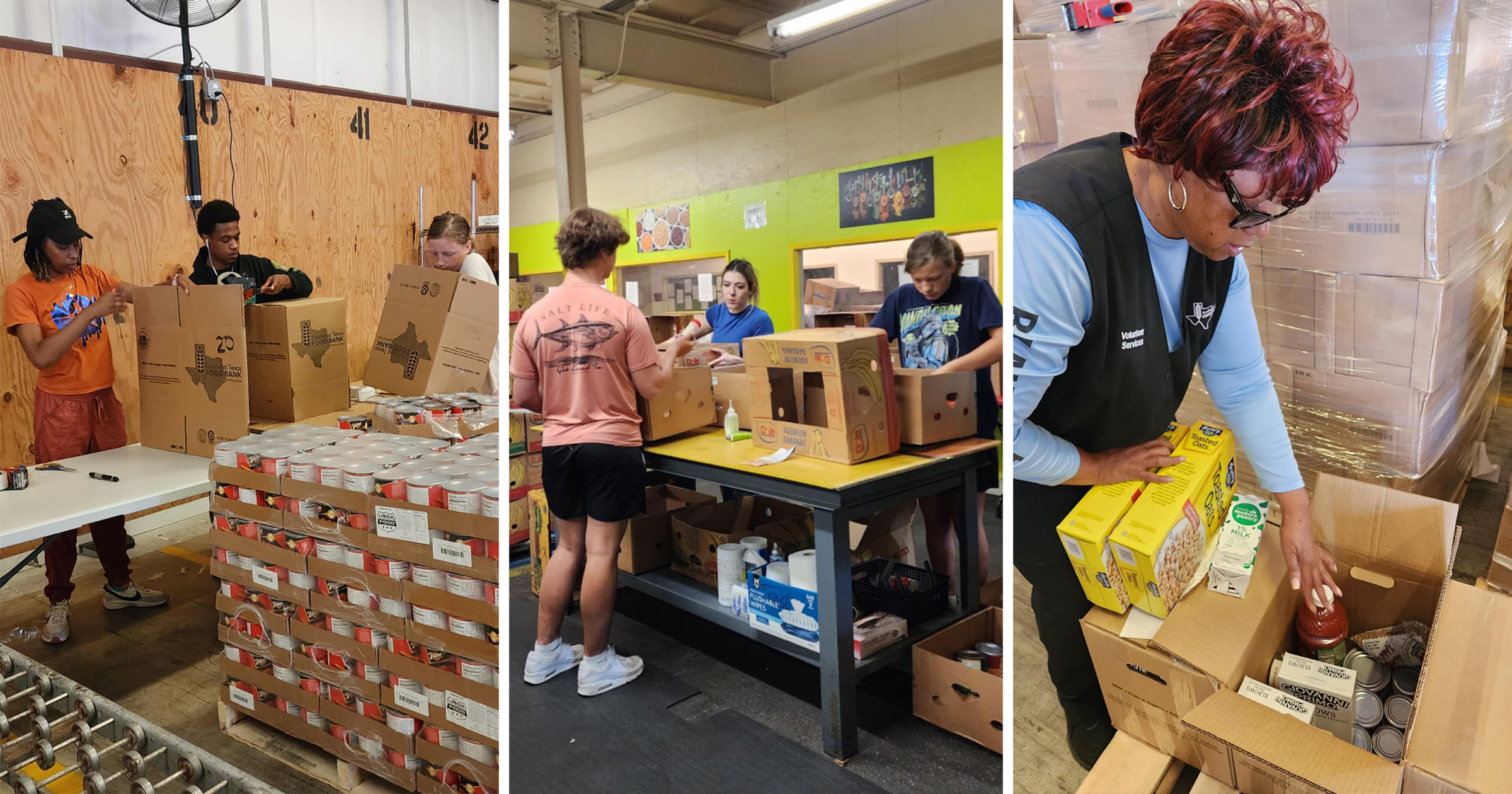
Southeast Texas Food Bank volunteers and Food Drive Coordinator Mary Simon pack senior boxes as uncertainty surrounds the future of the program.