

More than 70 attendees, mostly members of the Beaumont Police Department, gathered for a special ceremony Dec. 11 to honor Special Police Officer George Frederick, a Beaumont police officer who gave his life in the line of duty more than a century ago. The memorial was held at the Evergreen Cemetery, a Texas State Historic Cemetery, behind First Full Gospel Baptist Church located on Pine Street.
On May 3, 1902, Frederick, 41, was off-duty at his home when he responded to gunshots at a neighbor’s house on Fifth Street. He discovered that Ella Dickinson had shot her sister, Zena Bayo. While attempting to arrest Dickinson, Frederick was fatally shot in the face. Despite his injury, he returned fire, striking Dickinson, who died the following day. Frederick succumbed to his wound on May 7 and Bayo survived the tragic incident.
Highly regarded in his time, Frederick’s funeral expenses were paid by the city. However, the exact location of his burial site remains unknown, as statewide birth and death registrations in Texas did not begin until 1903.
In recognition of his sacrifice, Frederick was added to the Beaumont Police Department’s (BPD) Officers’ Memorial in 2022, followed by his inclusion on the Texas and national police memorials in Washington, D.C. He was also the first known black BPD officer.
During the ceremony, which was opened by Police Chief Tim Ocnaschek, the BPD Honor Guard presented the color and the department’s rifle team of seven officers fired their rifles three times as a salute to the fallen officer. Also, Vidor Police Department Officer Jeff Courts played “Amazing Grace” on his bagpipes.
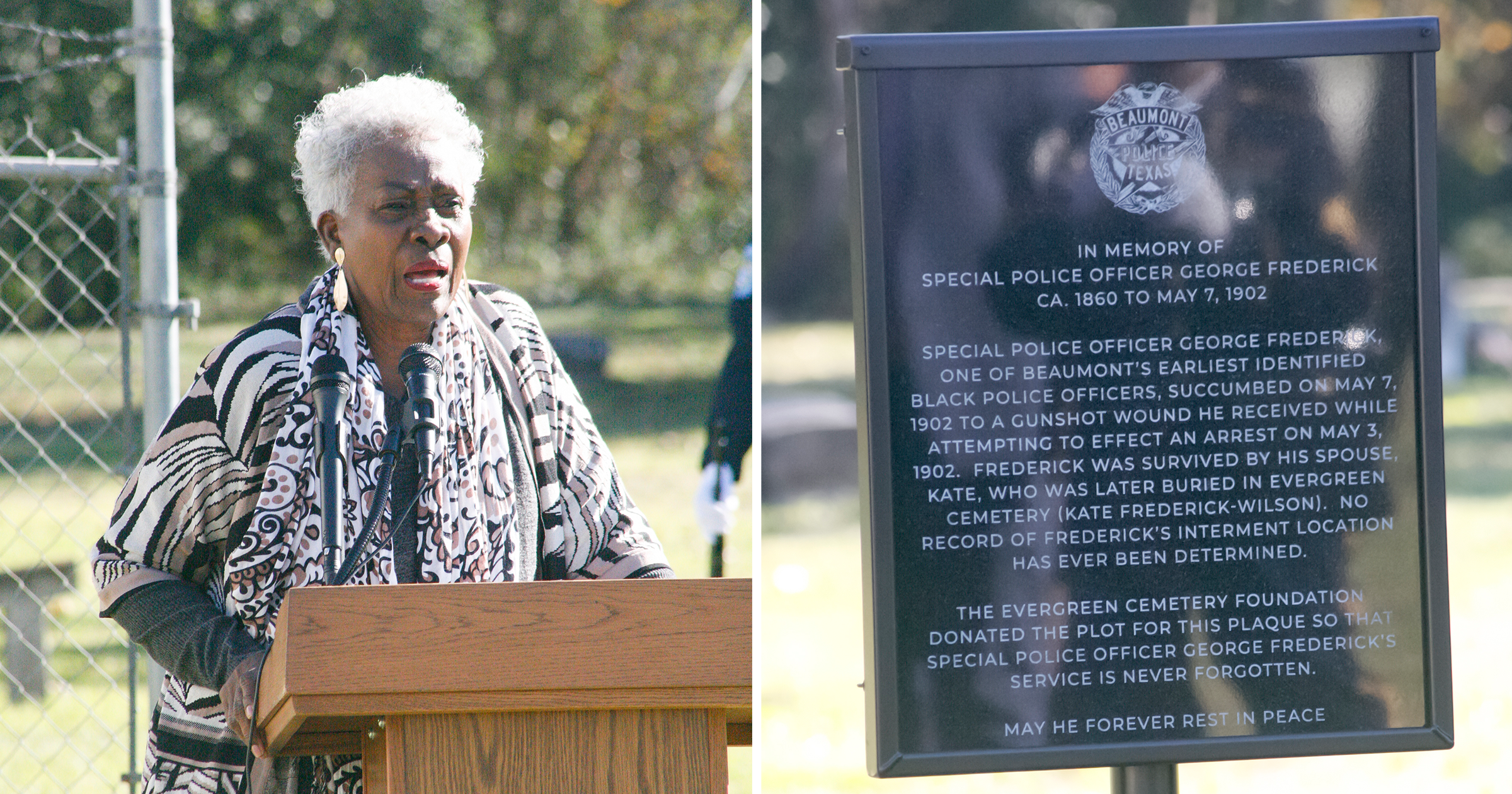
This year, Operation Blue Remembrance, a nonprofit organization co-founded by retired Baytown Police Officer Bert Sims, donated a granite plaque to commemorate Frederick. Operation Blue Remembrance provides gravestones and plaques for officers who died in the line of duty but were buried without proper markers.
According to Sims, his organization has been to 1,400 sites over six states individually marking graves.
“I’ve been told no one will ever know the difference,” said Sims, who added, but, “we will.”
“The officers are family, a family of men and women with life goals and common bonds,” Sims said. “A bond of duty and of the cost, a bond of community service regardless of the sacrifice and a bond of protection of the vulnerable, regardless of the outcome.”
Frederick was survived by his wife, Kate, who was also interred at Evergreen Cemetery.
Managed by the Evergreen Cemetery Foundation, the cemetery is also the final resting place of notable veterans, including a Buffalo Soldier and a member of the 370th Brigade. Sandra Wilturner, president of the foundation, provided a space for Frederick’s memorial marker.
“I want to thank all of the officers and all of the patrons and friends that have participated, and for coming into our little cemetery,” she said, adding that the cemetery clean-up resulted in historic finds of importance to all of Southeast Texas. “Once we began to dig into what we had back here, we realized we had a treasure. It wasn’t just African Americans or just whites, and it wasn’t just people of insignificance.
“I was taught that cemeteries were a map to who we are in a community. And, there is also a blueprint to let people know who was here, who died, and also what family members remained here.”
While the exact location of the officer’s burial remains unknown, BPD, Operation Blue Remembrance and the Evergreen Cemetery Foundation believe the officer deserves a lasting tribute. The marker is housed in a custom rack built by Mike Ratliff of Ratliff Industries, with support from Chief Earl White of the Beaumont Fire Department, who covered the cost of powder coating. BPD’s Traffic Unit installed the marker in preparation for the ceremony.
.