

.
Read a full breakdown of all of the Beaumont bond propositions at www.theexaminer.com/news/breakdown-beaumont-bond-propositions
At a time when many residents of Beaumont are barely making ends meet amid the rising costs of groceries, housing, health care, child care, car and home insurance, and more, City Council and administration is asking the public to voluntarily raise their own taxes to pay for a laundry list of needs and wants that staff has not attended to with the constantly-rising tax base already afforded to its coffers. Regular raises for all staff, tens of thousands of dollars for administrator “bonuses,” and taxpayer-funded contracts for consultants to advise employees in their top-dollar roles receive consistent funding — but routine maintenance and security upgrades for police and fire don’t make the budget cut so voters are being asked to give the city more money to cover the costs taxes fund in other cities.
“We’re moving kind of fast and furious,” Mayor Roy West said of rushing to call a bond proposition just a couple months before voters would need to weigh-in. A citizen bond committee had made recommendations for proposed bond propositions totaling $210 million, reduced from the $1.3 billion in projects under consideration, but council had differing opinions of what the citizens really needed.
“Maybe we can get rid of something less important,” Councilmember LaDonna Sherwood added to the mix when the elected officials were tasked with culling the bond project list to something more palpable for the residents absorbing the cost, or breaking out projects for individual vote, “maybe the animal shelter or the fire department … but the Riverfront Park is staying.”
Citizen feedback reported by the city indicated residents want infrastructure improvement, but the final bond propositions reflect approximately just 20% dedicated to drainage, streets, and sidewalks, representing $58 million of the total $264 million requested.
“Residents strongly want drainage, streets, and sidewalks fixed before other projects,” city bond documents read. The documents further reflect that residents agree that downtown improvements are risky and question the value in funding a project that serves too few at a cost to too many. Still, the bond propositions heavily fund projects such as a $50 million sports complex and $25 million in Tyrrell Park upgrades. The bond committee did propose allowing voters to weigh-in on the sports complex, but recommended the project stand alone in a proposition to give residents the opportunity to vote to fund needs even if uninclined to fund extra frills.
Bond consultant Gap Strategies did not present the citizen bond committee advisories when recommending the council take on more funding, more projects and lumping projects together as voters couldn’t be entrusted with voting on projects individually.
“Prioritizing the neediest of the needy,” is what Jeff Barton, of Gap Strategies, said the new recommendation was doing. The end result, in Barton’s opinion, is representative of the bond committee proposal – even if it isn’t the actual proposal, the numbers, or the items proposed for vote. It is, he said, “Keeping in the general direction.”
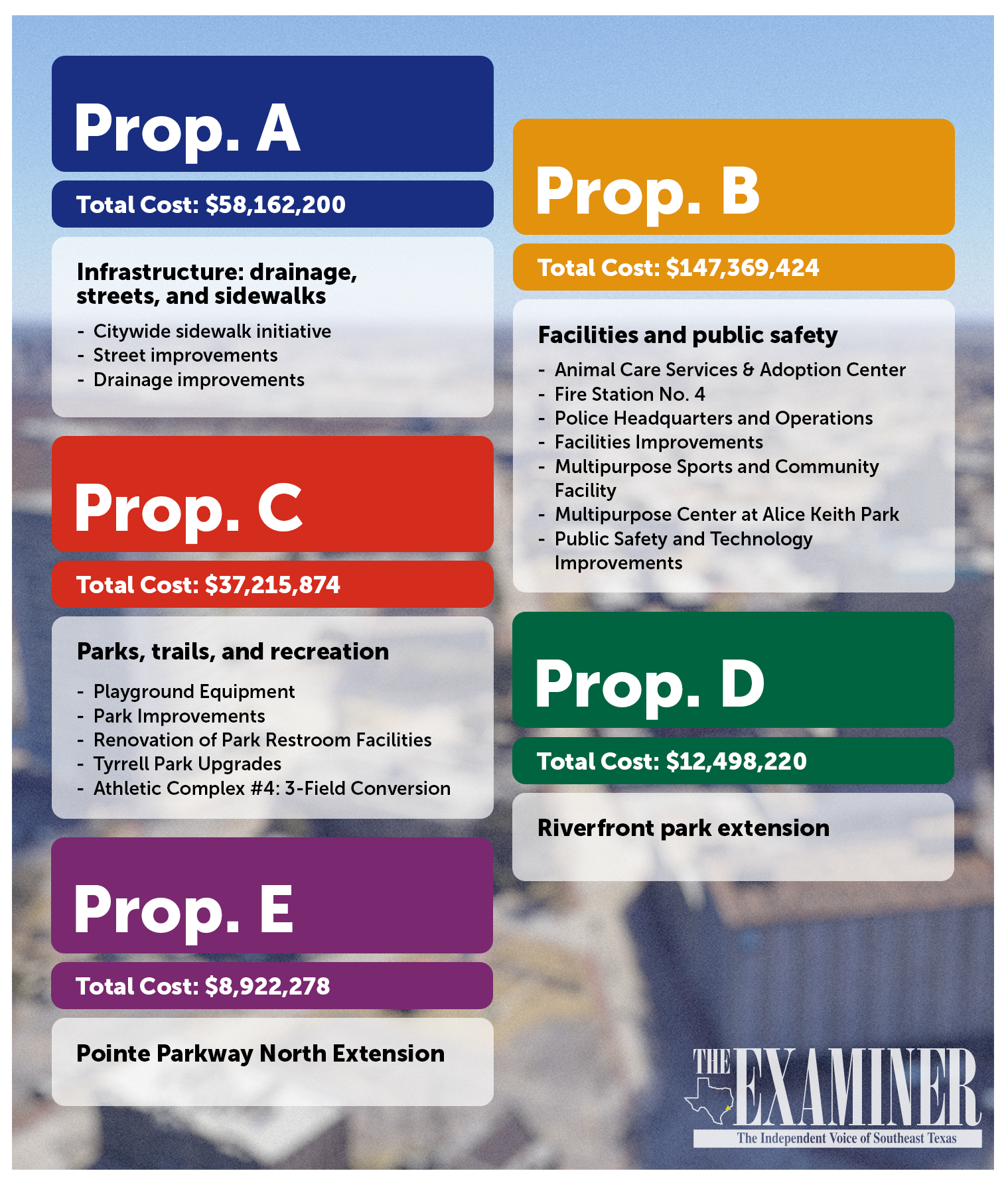
Now, voters are asked to fund a total $264 million bond package set at $58.1 million for Proposition A, streets, sidewalk and drainage; $147.3 million for Proposition B, a seven-pronged patchwork of everything from sports facilities to police cameras; $37.2 million for Proposition C, parks and recreation upgrades; $12.5 million for Proposition D, solely comprised of Riverfront Park upgrades; and $8.9 million for Proposition E, which is solely set aside for the Pointe Parkway North Extension.
“It’s a tremendous risk in what they’re doing — and I commend them,” City Manager Kenneth Williams said of the elected city council members responsible for calling the election. Councilmember Cory Crenshaw, the lone vote against the package as presented, was notably absent from the after-hours press conference held the day council called for the vote, Aug. 12. In attendance, however, was a representative from Gap Strategies and other city departments receiving upgrades from the initiative. Pointing to those lined against the walls, Williams said, “The ones still here, they got something out of this deal.”
Sept. 2, Mayor West tilted the scales of a City Council tie vote to once again hire Gap Strategies to provide election services at a cost of nearly $100,000. The narrowly-secured vote of 4-3 contracted the services of the Buda-based consultant linked to the only bond election overturned by judicial ruling, despite sharp pushback from several council members that argued the city’s own staff could handle the work.
Supporters of the contract said the firm’s expertise would be critical in ensuring accurate and legally compliant communication with voters, while opponents questioned the price tag and the need for an outside consultant to “educate” voters about what should be straight-forward information.
Assistant City Manager June Ellis defended the decision to pay for Gap Strategies by indicating the firm was instrumental in getting the recommended bond propositions before council. Ellis said he felt it would be useful for Gap to continue to assist and support the communication department.
“Could we do it without them? Yes,” Communication Director Tracy Kennick confirmed. “Will they make us better, probably so. There’s a lot of things outside of my wheelhouse.”
Kennick emphasized the importance of “legal guardrails” surrounding the city’s upcoming bond election, pointing to the expertise of Gap Strategies as a reason for rehiring the firm. During Gap’s presentation to the Beaumont City Council, the consultants highlighted their past work with Hays County as an example of their successful consulting services. However, the same Hays County bond election Gap Strategies consulted on has since come under scrutiny. In June 2025, 419th Civil District Court Judge Catherine Mauzy voided Hays County’s 2024 General Obligation road bond election, ruling that the county commissioners violated the Texas Open Meetings Act when calling the special election.
The court determined that Hays County failed to provide sufficient public notice about the bond’s cost, scope, and potential tax impact. The lawsuit, filed on Oct. 21, 2024, alleged that county officials misled residents by placing the bond item on a meeting agenda at the last minute — limiting public input and leaving voters without enough information about how the bond would affect local property taxes.
In the meantime, despite the expertise of Gap consultant guidance through what is described as “legal guardrails,” Hays County taxpayers will foot the bill for legal costs, the consulting fees already paid to Gap Strategies, and now face the possibility that much-needed road repairs will not move forward if the county loses its appeal.
Kennick acknowledged that she has relied heavily on Gap Strategies for guidance in Beaumont’s own bond efforts.
“I have used them as consultants with everything that I have put out regarding the bond,” she said, describing the process as “super time consuming.”
Gap Strategies, as explained of the new contract, would handle a range of tasks, including social media campaigns and direct mail outreach.
“They have been super successful; they’ve done this plenty of times,” Kennick said, adding that the firm’s fee could be rolled into the bond itself.
Councilmember Mike Williams argued the arrangement to add “communication” cost to taxpayers already footing an annual bill was unnecessary and costly. Kennick then stressed that most city employees were not equipped to answer detailed questions about the bond.
“How many of them are knowledgeable about the bond – not that many,” she said. “Most of our staff, if you were to ask them, tell me why this was put on the bond, tell me what’s needed at the police station – they probably couldn’t even tell you that.”
“This is not money out of our tax dollars now … if that bond passes, this is paid for out of that,” City Manager Williams added. “If you want it to be successful, you should put more effort into it. It provides an unbiased perspective, and my staff is already getting accused of being biased in this election. Council can do as it pleases but don’t come at my staff later about being biased when we had the opportunity to let somebody else do it.”
Mayor West said that, while continued use of Gap Strategies was not initially expected, he was persuaded by their presentation and experience.
Beaumont voters will decide to approve or deny a total of $264 million in a General Obligation bond election Nov. 4. Should all propositions pass, taxpayers will pay an additional $171.00 per $150,000 taxable property valuation for an undetermined number of years. According to city data, if all are approved, the total to be repaid by Beaumont taxpayers is expected to total more than $500 million for 20 years.
Early voting by personal appearance will run through Oct. 31, with Election Day set for Tuesday, Nov. 4.
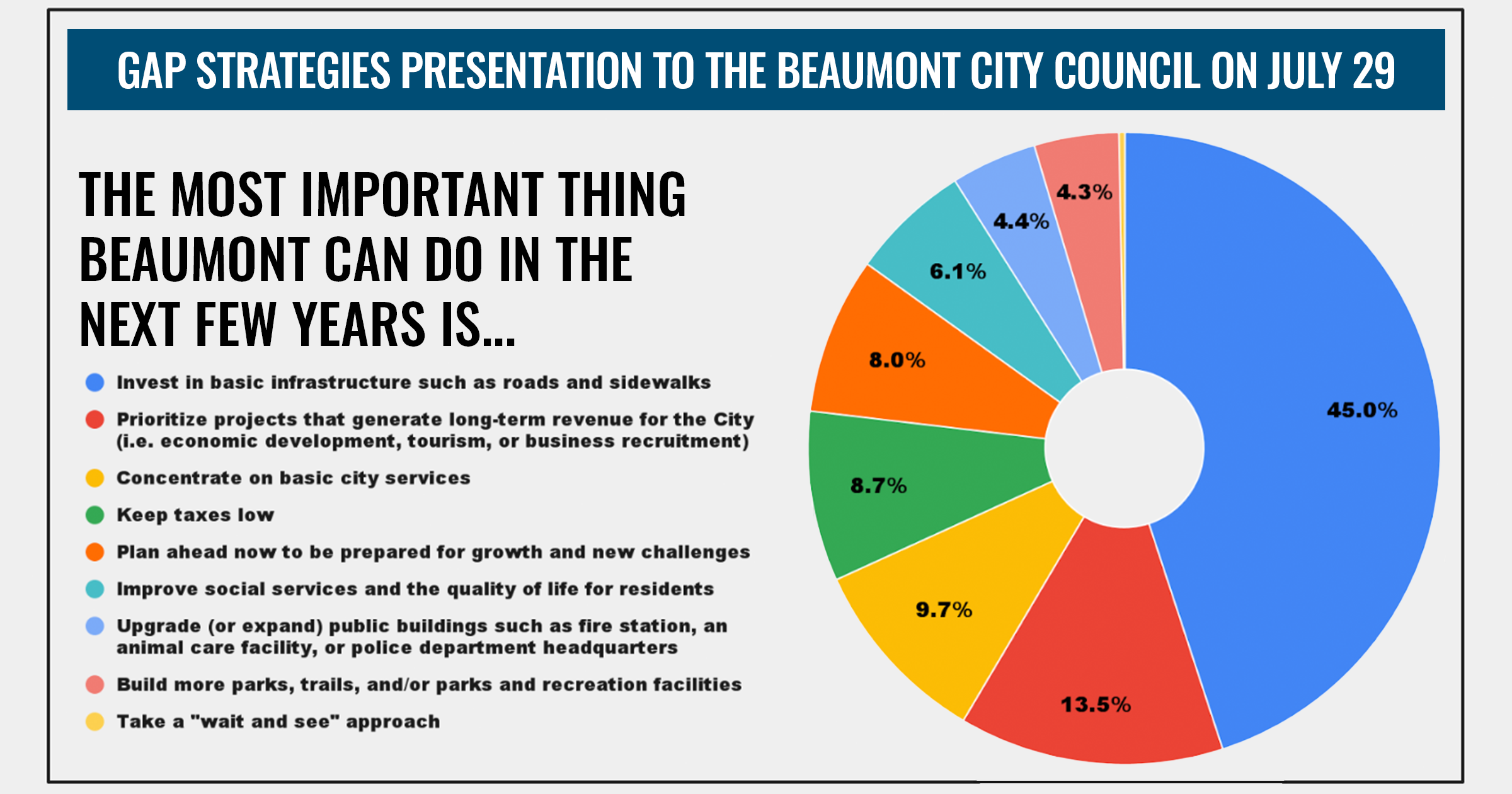
In the Gap Strategies presentation to the Beaumont City Council on July 29, elected leaders were presented with official results of an unofficial poll open to anyone with internet access. Still, respondents were clear in prioritizing infrastructure improvement over tourism projects.