

Beginning Oct. 16, provisions of the Lead and Copper Rule Revisions Requirements went into effect in addition to previous lead and copper rule requirements. Water departments were required to submit initial service line inventory reports to Texas Commission on Environmental Quality (TCEQ) by Oct. 16, indicating whether service lines materials were lead, galvanized steel, copper, brass or plastic.
According to information provided by the city of Beaumont, homes built before 1988 may have lead pipes that connect the home to the city’s water mains, but homes built after 1988 should not have a lead service line.
To meet compliance, Beaumont water department sent letters to customers with unknown service line materials containing instructions on how to identify and self-report materials to the water department. The letter leads customers to the city’s lead and copper public water safety program website (https://tinyurl.com/3xczn78p) where step-by-step instructions, as well as the reporting survey, can be found.
To determine and report service line material, do-it-yourselfers will need a house key, coin, flathead screwdriver or paint scraper and a strong refrigerator magnet.
Step 1: Identify where the home’s service line enters. This could be through the wall at the front, side, or back of the house, or in the crawl space underneath. It may also enter under the slab, in which case it may not be visible.
Step 2: Pull back the insulation around your service line.
Step 3: Use the house key or coin to carefully scratch the pipe surface.
Step 4: Compare the scratched area to the following descriptions:
a. If it looks shiny and silver, the pipe is lead. A magnet will not stick to a lead pipe.
b. If it is a dull gray color with no noticeable scratch on the surface, the pipe is galvanized steel. A magnet will stick to a galvanized steel pipe.
c. If it is the same color as a penny, the pipe is copper. A magnet will not stick to a copper pipe.
d. If it is smooth and red, blue, white, or black, the pipe is plastic. A magnet will not stick to a plastic pipe.
After determining the service line material, residents should report their information on the survey online via the city’s website as mentioned above, by phone at (409) 730-4406 or via email to Makenzie Watts at LCRR.Water@beaumonttexas.gov.
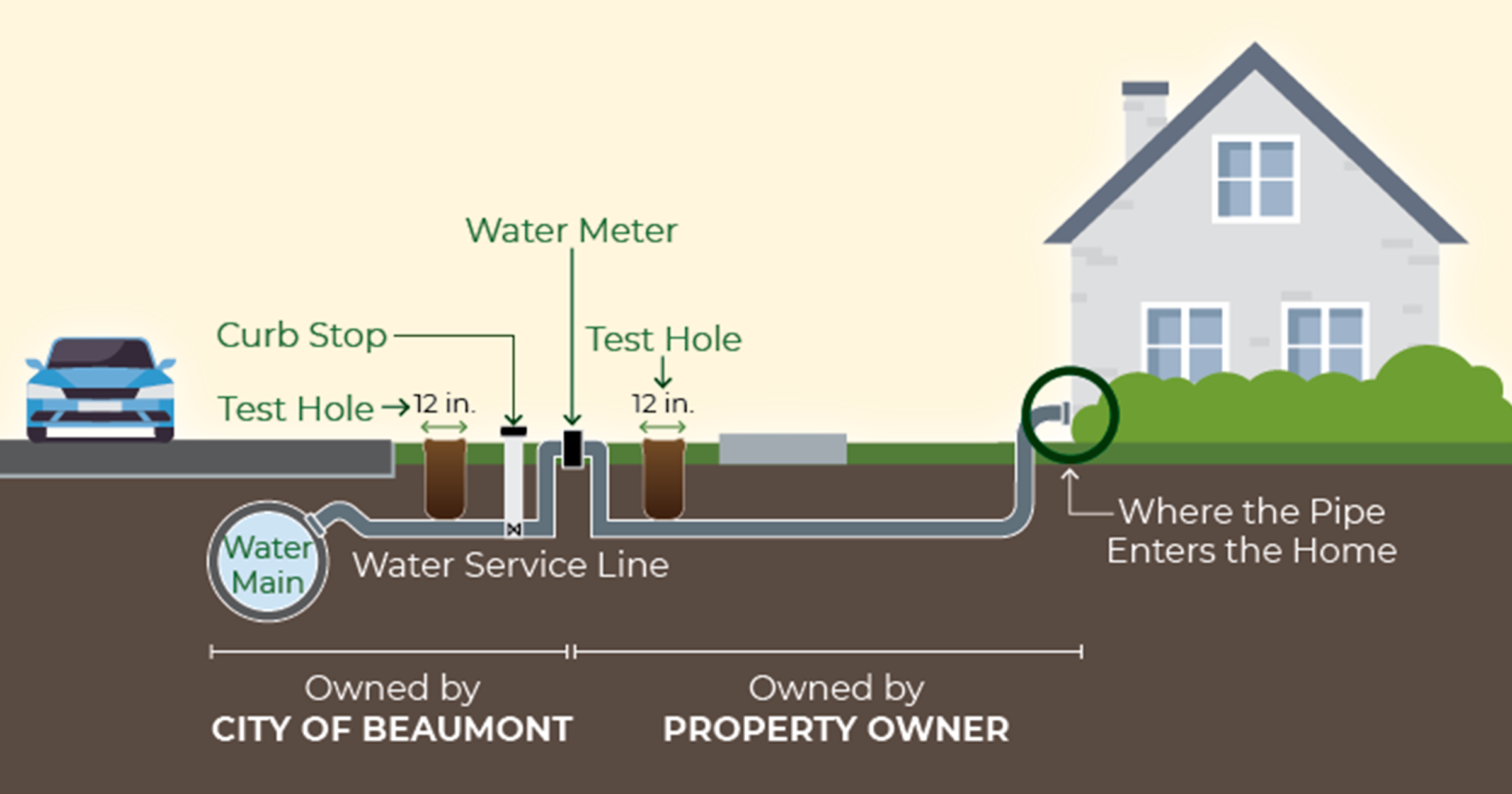
For customers not self-reporting, Beaumont staff will dig small test holes outside of the home to reach the pipes underground. This process will require a 12x12 inch hole on either side of the meter to determine the service line material. The process takes approximately 30 minutes and residents do not have to be home for this work to be completed.
“Once we look at the line, the contractor will fill in the hole and level it with topsoil. Depending on the ground surface, the city will return to seed, pave or replace sidewalks as needed to restore the area to its original condition,” the municipality advised.
Once done, the contractor should leave a door hanger noting the line’s material; customers are urged to keep this hanger for their records. If the line is lead or galvanized steel, the resident will receive additional information on how to protect from lead in drinking water.
According to the TCEQ, exposure to lead can cause serious health effects in all age groups. Infants and children can have decreases in IQ and attention span. Lead exposure can lead to new learning and behavior problems or exacerbate existing learning and behavior problems. The children of women exposed to lead before or during pregnancy can have increased risk of these adverse health effects. Adults can have increased risks of heart disease, high blood pressure, kidney or nervous system problems.
The city of Beaumont is in the early stages of developing a replacement program to comply with the EPA’s Lead and Copper Rule Improvement, which mandates the replacement of all lead and lead-containing galvanized service lines. The city is set to create a replacement plan for affected lines; however, residents are responsible for covering costs associated with replacing private service lines (the section from the meter to where the pipe enters the home). The city is actively exploring federal funding options to help offset these expenses, according to correspondence from administration.
.