

March 18, the Beaumont City Council voted 6-1 to approve an ordinance declaring the fire-damaged Gilbert Building in downtown Beaumont an “imminent danger.” The ordinance orders owner Tom Flanagan to demolish the structure within five days; the move follows a public hearing and the property owner’s sometimes contentious public presentation about progress in getting the building up to code.
Unless Flanagan files for and obtains an injunction to halt the process, the city has the legal authority to proceed with demolition if he fails to act. According to Demi Engman, Beaumont’s director of planning and community development, this could cost the city approximately $400,000.
“We got a loose bid for about $400,000, and it’s unfortunate that it’s even being considered on the taxpayers’ backs; however, if we were to do it, it’s going to follow the same exact procedure – just like a litter clean up. We are going to perform the work; once it’s done, we get everything to central collections, invoice the property owner and, if he does not pay the city back, a lien is placed on his property,” said Engman.
According to Engman, prior ordinances that allowed for an April 23 extension required Flanagan to disclose his intent, timeline and plans for the building by March 11, which was not received aside from a letter of intent received March 13.
According to Beaumont Building Official Boyd Meier, the building remains an imminent danger, as the loose coping remains and presents a present danger. Meier also stated that boarding and securing of the parameter, which was ordered months ago, had yet to be completed.
As to the integrity of the building and whether it is structurally sound enough to believe it does not pose an imminent danger at risk of collapse, Meier said officials are waiting on the report from Alliance, the engineer being paid by Flanagan, to make that determination.
Rob Fuselier, president at Alliance Engineers & Project Consultants, LLC said they are “dead on schedule” – referring to the schedule modified and provided to now be revision E from Feb. 14.
“It’s easy to have a schedule that shows you’re on track when you update the schedule,” replied Councilmember Taylor Neild.
According to Engman, aside from incomplete demolition, no repair work has been done, therefore building officials recommended a raze order to demolish… “for the preservation of life, property and safety of the public.”
In a heated exchange of words, Councilmember Ward 4 Chris Durio told Flanagan he didn’t appreciate the city being blamed for the damage at his property and reiterated to him that the city’s job was to protect the citizens and Flanagan’s to secure his building.
Mayoral hopeful and Councilmember At-Large Randy Feldschau probed Flanagan as to whether his record of follow through with the city has been adequate with this and other projects, even asking him if he had the working capital to invest in the building. “We’re a taxing entity, help me understand…as a taxing entity how do we deal with the back taxes…there’s a report of 11 buildings with over $300,000…a good faith gesture to the city would be to help us understand.”
Flanagan responded detailing a problem over the last several years, stating the appraisal district increased assessments on his commercial properties 300-1,000% without an appraisal or justification. “We fought that…it took us two years, if we had not won that you might as well drop an atomic bomb here – this property would be radioactive. Nobody would buy a building, insure it and pay hundreds of thousands of dollars just to let it get attacked, broken into defaced and burned.
“The majority of our properties are paid up and there are some of our older ones that were caught up in that dispute that we are paying off,” said Flanagan. “It was an outright money grab for bureaucrats to pass an unvoted tax increase.”
“Nobody could be going through what I’ve been through and not be humbled by it…I love the city and I’ve shown that…this is an enormous project…we’ve been very tenacious about this,” Flanagan said, adding that the process has been overwhelming “in the press, social media, law enforcement,” saying those things have forced him to get behind on some of his other projects. “It’s not just a fire hit the building, but hit my life – I’m proud of what we’ve done, we’ve got a lot of catching up to do on some of the other buildings because of this.”
When asked if his desire to reconstruct the building is contingent on the passage of the riverwalk, Flanagan said it is not and, after boasting that he’s “done more development downtown than anybody,” Flanagan said he hoped, in the next 3 – 5 years, to turn the Gilbert Building into an apartment building.
“The vacancies downtown are caused by a directionless city…when the city gets direction and puts the environment together, the buildings will be developed,” asserted Flanagan.
The March 13 edition of The Examiner revealed Flanagan’s 304 Pearl St. property – formerly the Workforce Building – was set to be sold at a minimum bid of $27,365.03, in an attempt by taxing entities to recover delinquent taxes. The 79,845-square-foot building, situated on 1.83 acres, was initially assessed at $1,511,610 in 2019 when Flanagan’s Goodhue Development LLC purchased it from Wells Fargo Bank.
However, after losing the property in an Aug. 1, 2023, Sheriff’s Sale for delinquent taxes and later repurchasing it from LJM Ventures LLC for $437,500, the downtown property’s current assessed value stands at $251,859. The day following publication of the above-mentioned article, March 14, a $13,550 payment was made to cover part of 2023 and all of 2024 taxes. Therefore, although a total of $13,542.28 remains due for 2021- 2023, the property will not be sold at the April 1 Sheriff’s Auction for Delinquent Taxes.
Flanagan remains under investigation, named as a “person of interest” in the arson that destroyed the Gilbert Building on June 6, 2024.
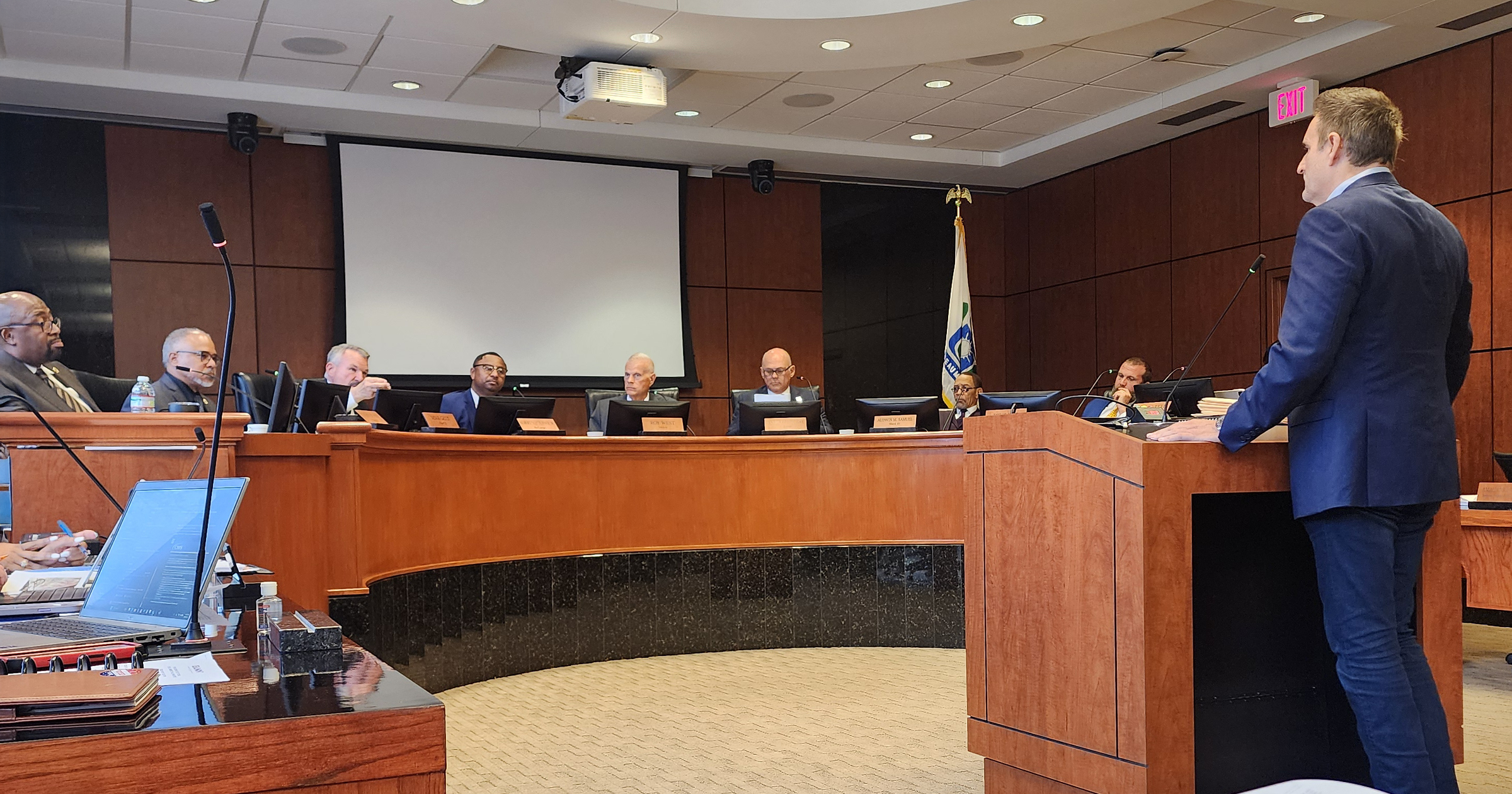
Flanagan speaks before city council March 18. (Photo by Barbara Davis)