

March 25, in the wake of community outcries for law enforcement agencies and the criminal justice system to curb violence in the city of Beaumont, local, state, and federal law enforcement agencies announced the creation of the Southeast Texas Violent Crime Task Force, a coordinated regional effort aimed at reducing a recent surge in violent crime and targeting repeat offenders across jurisdictional lines.
The task force, led by the Beaumont Police Department, brings together a wide range of agencies including the Jefferson County Sheriff’s Office, Texas Department of Public Safety, Jasper and Nederland police departments, as well as federal partners such as the FBI, ATF, DEA, Homeland Security, and the U.S. Marshals Service.
Officials said the initiative has been in development for months and represents a shift toward intelligence-driven policing, shared resources, and coordinated prosecution strategies at both the state and federal levels.
“This is a unified effort,” said Beaumont Police Chief Tim Ocnaschek during the March 25 announcement. “The criminals don’t respect jurisdictional boundaries.”
Law enforcement leaders emphasized that the task force will focus on identifying and targeting individuals responsible for the majority of violent crimes in the region — many of whom are repeat offenders already known to authorities.
“A small percentage of people are committing crimes over and over and over,” said Jefferson County Sheriff Zena Stephens. “We need to identify those people.”
The task force announced it will meet regularly, share intelligence, and pursue cases strategically, allowing agencies to determine whether charges should be filed at the local, state, or federal level — often opting for federal prosecution when it offers stronger penalties.
Warzone: Beaumont
March 24, even as city administrators, including the mayor and city manager, were celebrating their self-touted successes “Oscar-style” in downtown Beaumont, police officers were at the scene of yet another violent crime, this one with at least one teen arrested for involvement in a shooting that left a 31-year-old man dead in his West End home.
For days leading up to the March 24 murder, officers were making arrest after arrest for a cadre of youth involved in a shooting at Rogers Park the week prior. Among those arrested for the crime are Dontae Perkins, Christopher Herring, Alexander Perkins, Eva Williams and Javion Boykin.
Williams was arrested after BPD detectives identified suspects using video footage from BISD PD cameras at Marshall Middle School, across from Rogers Park and impacted by gunfire from the day of the shooting, that revealed a vehicle used to transport suspects and weapons from the scene.
The vehicle description was shared with the Real-Time Crime Center (RTCC), which identified the vehicle. March 20, a BPD officer located the suspect vehicle in the 2700 block of Euclid and conducted a traffic stop. The driver, Williams, 18, of Beaumont, was detained.
Detectives then executed a search warrant at a residence in the 2700 block of Euclid. During the search, officers recovered several firearms and narcotics, including suspected Ecstasy, THC vape pens, and marijuana.
Williams was arrested and charged with two counts of possession of a controlled substance and possession of marijuana. A separate federal investigation has been launched into the firearms and narcotics violations.
Additionally, Special Crimes detectives obtained a directive to apprehend a 15-year-old male juvenile for unlawfully carrying a weapon in connection with the shooting. The juvenile was taken into custody at his residence and transported to the Minnie Rogers Juvenile Justice Center.
Police are still searching for even more related suspects.
Calling on the calvary
While leaders presented a united front in launching the task force March 25, official remarks revealed differing philosophies on how to address the root causes of violence.
Ocnaschek stressed that enforcement alone will not solve the problem, calling for broader community involvement.
“We can’t arrest ourselves out of this problem,” he said. “It’s going to take accountability at every level… Parents and guardians play a critical role.”
The veteran law enforcer pointed to a troubling trend of young people becoming involved in serious crimes and urged community members to engage not only after incidents occur, but in prevention efforts, as well.
Stephens, however, took a more enforcement-focused stance, downplaying discussions around underlying causes and social interventions.
“Me, and my guys, are committed to catching the bad guys,” Stephens said. “And, so, while everybody in our community, lots of people on social media, are talking about the causes of the problem, I’m not really concerned with that.”
Her focus, she said, is clear: “I’m concerned about catching the bad guys, prosecuting the bad guys, and putting the bad guys in prison for long periods of time.”
Stephens also pushed back against calls for community-based solutions centered on youth intervention.
“People keep calling me and saying, ‘Sheriff, Sheriff, what can we do to help the kids?’ That’s a social worker’s job,” Stephens asserted, also acknowledging her care and concern for the youth as a human being. And, while the sheriff said she supports programs such as “Cops and Kids” and youth mentoring initiatives, “17 to 25-year-olds pointing guns in people’s faces are not children, and no feel-good program is going to stop that…that’s for kids in school, not young adults hurting our community!”
Despite the differing approaches, both leaders agreed on the urgency of addressing violent crime and the need for coordinated action.
Strains between the lanes
Although standing together in a united front against violent crime and for the safety of the communities they serve, the creation of the task force is not immune from longstanding friction between law enforcement agencies and the District Attorney’s Office over how violent crime cases are handled.
Police officers expressed frustration that individuals they arrest for violent crimes are habitual offenders — often already on probation for another crime. With a backlog in the criminal justice system, some offenders are on bail for violent crime when they are again arrested for subsequent criminal activity. Others arrested for violent crime, police dismay, are granted probation; some even receive deferred adjudicated sentences. Those actors, law enforcement alleges, are “frequent fliers,” known to the police, and active in crimes throughout the community.
“Within the last couple of weeks…we’re doing probation checks, those are the same people that are committing these crimes…I’ve got a list of folks who are on probation…we’re going to be knocking on your doors, we’re going to be finding where you are, seeing if you’re violating probation,” said Stephens.
At the same time, prosecutors argue that many cases brought forward by law enforcement are difficult — or impossible — to win in court.
In an exclusive interview with The Examiner, Jefferson County District Attorney Keith Giblin acknowledged aforementioned challenges, explaining that some plea deals stem from weak cases and unreliable witnesses.
“A lot of these cases are indicted, but once our prosecutors look at them, they see there’s no way to win the case and take the best they can get,” Giblin said. “Sometimes, at least if they are on probation, we have an opportunity to get them again if they mess up… and sometimes that’s the best we can do.”
Giblin pointed to uncooperative victims and witnesses as a significant barrier to successful prosecution.
“There are a lot of cases where the victims cannot be located or witnesses have decided not to testify,” he said.
Still, the use of probation in violent crime cases has drawn scrutiny. When asked about the use of deferred adjudication on cases that aren’t even eligible for traditional probation — which can allow offenders to avoid a permanent criminal record — Giblin responded, “It shouldn’t happen,” adding that he was unaware of how frequently it was being used.
Giblin emphasized that any plea deal involving probation in violent or sexual assault cases must be approved by him or a supervisor.
“Any case where a violent crime or sexual assault happens and there is probation offered, it has to be approved by me or a supervisor,” he said, in reference to policy he said was updated within the last month.
A system in constraints
Officials also highlighted structural challenges within the criminal justice system, including a backlog of cases and limited court capacity.
“The courts are overwhelmed with cases and a huge backlog exists,” Ocnaschek said.
Giblin echoed the police chief’s concerns, noting that Jefferson County has the same number of criminal district courts it did decades ago, despite significant population growth.
“We’ve got to make the system more efficient,” Giblin said, calling on state lawmakers to fund additional courts.
Federal officials said the task force will allow prosecutors to pursue enhanced charges in appropriate cases, particularly those involving firearms, drug trafficking, and repeat violent offenders.
By embedding federal prosecutors within the task force, authorities stated an aim to streamline case development and increase the likelihood of securing long-term sentences.
Despite differences in tone and ongoing tensions within the justice system, officials agreed that the task force represents a critical step forward in addressing violent crime in Southeast Texas.
“This teamwork serves as a force multiplier,” Ocnaschek said.
Stephens underscored the enforcement message with a warning to offenders: “Everybody’s worried about whether the jail is full; we can find a place to hold you if you’re hurting our community.”

.
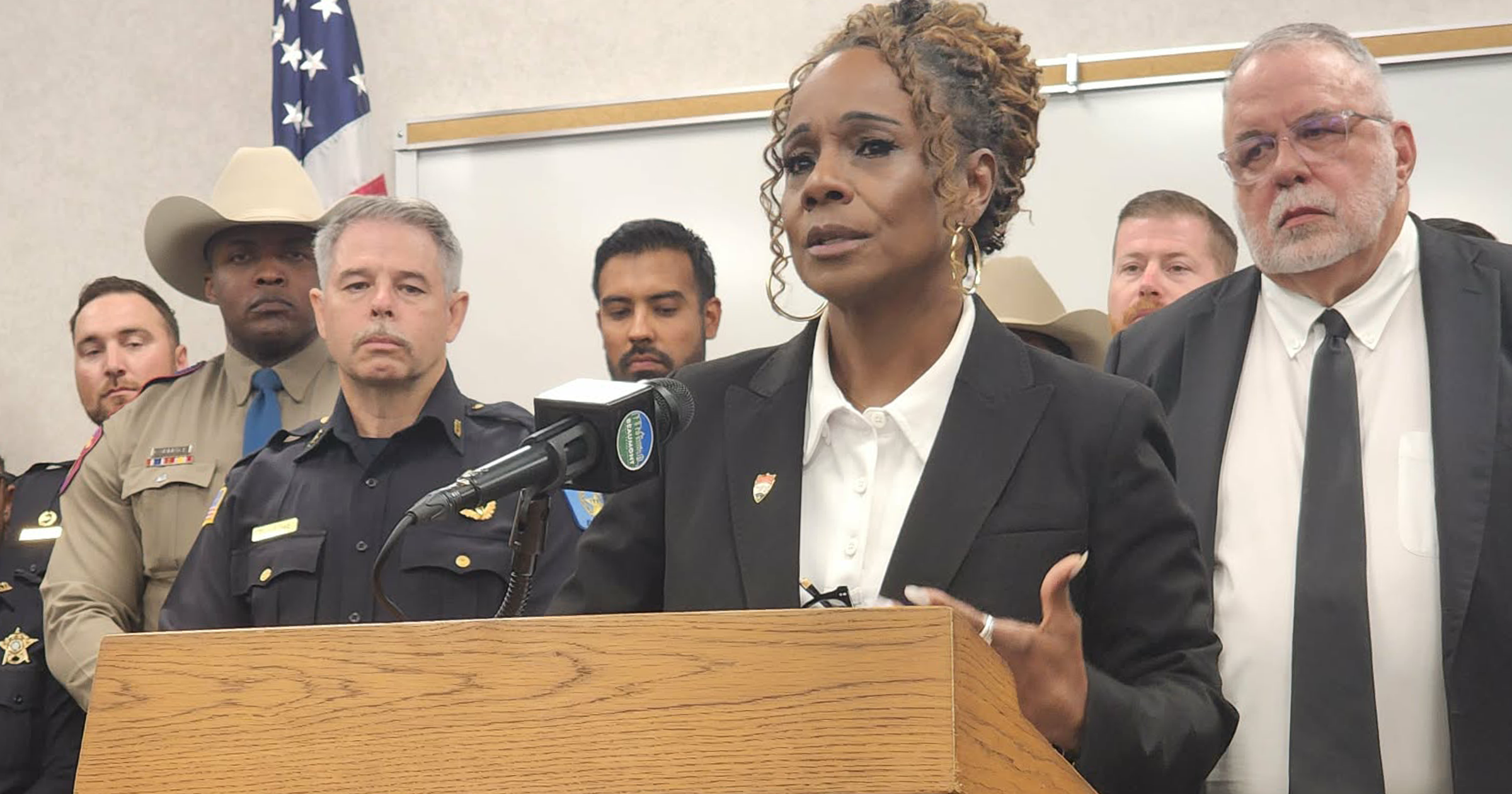
‘I don’t want you to think I don’t care about this community, but I’m tired of people getting shot,’ Jefferson County Sheriff Zena Stephens says of Southeast Texas violent crime.