

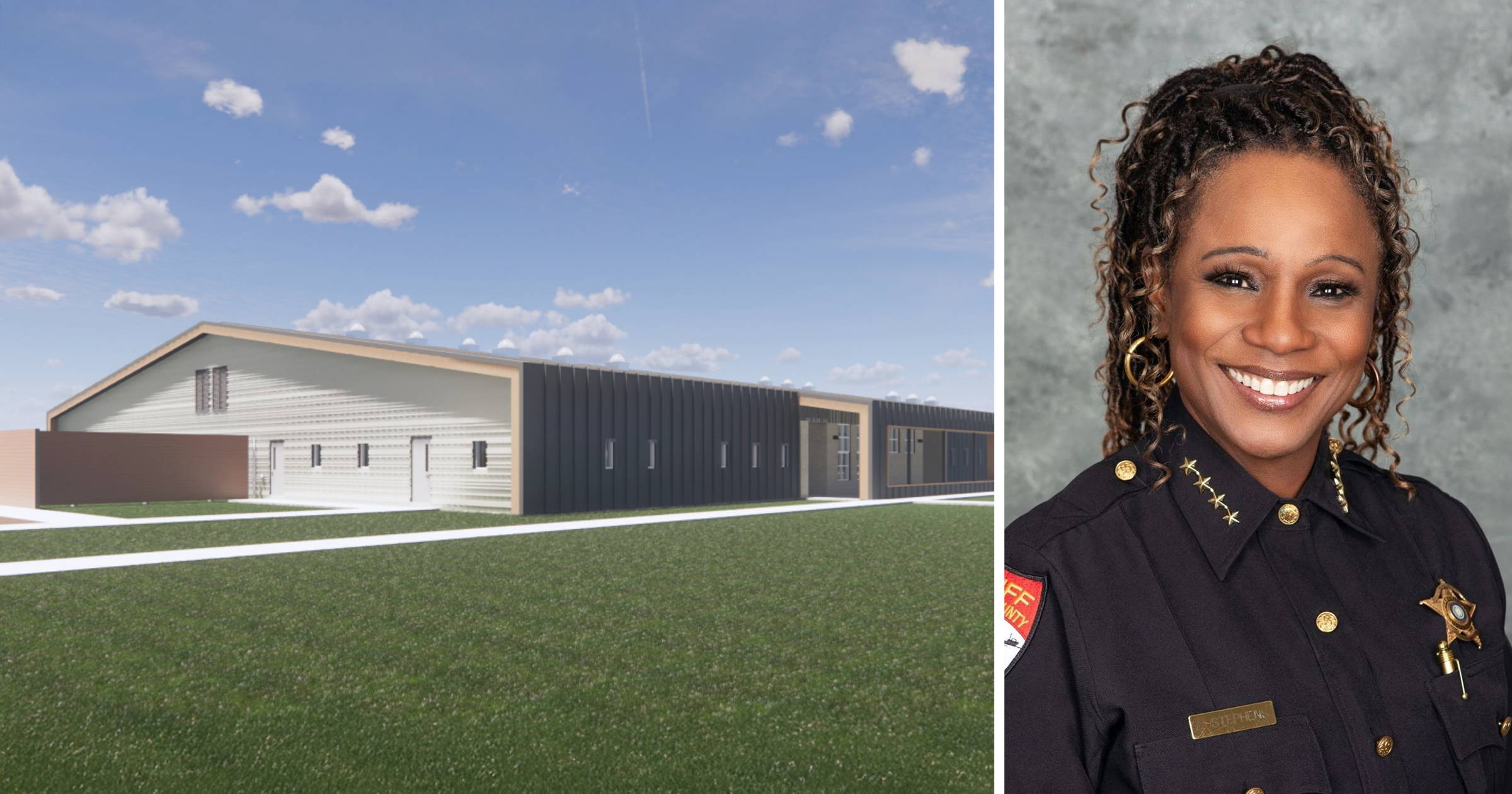
In the quiet expanse off FM 3514 in Jefferson County, behind a chain-link fence and nestled next to the Dream Center SETX, something extraordinary is taking shape – something that could fundamentally change how Southeast Texas responds to mental illness. The Jefferson County Diversion Center, currently under construction, is not just a facility; it’s a promise that those suffering from mental health crises won’t be treated like criminals. It’s a promise that jail will no longer be the first – and often only – option for someone in need of care. And, it’s a promise that compassion, not incarceration, can be the first line of response.
“We are trying to help people before they enter the judicial system,” said Sheriff Zena Stephens, who has passionately led the initiative to bring the facility to life. “Mentally ill people do not belong in prison.”
Stephens and Chief Deputy John Shauberger recently opened the doors for The Examiner to provide the first glimpse inside the Jefferson County Diversion Center. Still under construction, the facility is scheduled for its first phase of completion by the end of 2025. When complete, it will be a secure, standalone center on county property, but completely separate from the Jefferson County Sheriff’s Office (JCSO), both in operation and intent.
“This is not a jail. This is not a place of punishment,” Stephens assured. “It’s a place for healing.”
The goal is simple, but profound: instead of jailing someone in crisis – such as someone walking College Street in mental distress or trespassing due to delusion – officers can instead bring them to a facility where trained mental health professionals will assess, diagnose, medicate and connect those in need to community resources. And, the individuals who arrive? They’re not under arrest. They’re not charged. They’re simply choosing to seek help.
“They are free to leave at any time,” Shauberger said. “But, we try to stabilize them, connect them to the services they need, and get them back on a path to wellness before they do.”
Jefferson County’s jail, like many across the country, has unintentionally become the largest mental health provider in the region, but without the proper tools or environment to do so safely or effectively. Stephens is candid about the consequences.
“We’ve had people in our jail three or four years waiting on competency hearings,” she said. “And what we are seeing is the regression of people’s mental capacity when they sit there in jail – not getting better, getting worse.”
The sheriff described how jails, overcrowded and under-resourced, have become de facto holding facilities for the mentally ill, many cycling in and out without ever receiving true treatment.
“They lose their identity,” Stephens said. “They get really, really sick and hurt other people... We cannot house them in general population, which is high-conflict, high-stress and dangerous for everyone involved.”
The Diversion Center, funded through a unique coalition of local, state and federal resources – including $5.6 million from the American Rescue Plan Act, $2 million from the city of Beaumont, $540,000 from Port Arthur, and a grant through Spindletop Center – represents a major investment in public health. The total project budget currently stands at $8.5 million.
Construction began in January 2025. The first phase will open one side of the initial building with 32 beds. When fully operational, the building will serve 64 individuals at a time. Plans for a second building could expand capacity even further.
The facility, which once housed juvenile offenders for the state of Texas, will be reportedly transformed with trauma-informed design, replacing prison-grade doors and stark environments with softer, more therapeutic spaces. As described, there will be counseling rooms, exam rooms and a large multipurpose area for meals and group activity. Men and women will be housed separately. The center will provide services 24/7. Citizens can stay up to seven days – long enough to receive a diagnosis, begin medication and get a plan in place.
“By that time, you’ll have a diagnosis,” said Shauberger. “Whether they need to go to a mental health facility, like the new one at Baptist Hospital, or simply be stabilized with medication and outpatient appointments, we’ll help them figure that out.”
The Jefferson County facility is modeled after similar centers in Harris and Tarrant counties, the sheriff’s staff shared. Both templates have touted measurable success in reducing recidivism, police encounters and jail overcrowding. Shauberger explained that citizens will go through an intake process to determine the appropriate level of care.
“If they’re in active psychosis and could be a harm to themselves or others, they go to the hospital for emergency detention,” he said. “But, if they’re in crisis and need stabilization, we’ll keep them here, help set their appointments and, with Lamar University’s partnership, we’ll even follow up through case management.”
Lamar has already committed to providing interns and social workers to support the center’s operations, one of many community partners working to make the vision a reality. Despite all the planning and collaboration, Stephens acknowledged that this is just one step in addressing a broader crisis.
“We can’t save the world,” she admitted. “As much as we’d like to, we can’t. But, what we can do is stop treating mental illness like a criminal act.”
Her voice wavering with emotion, Stephens went on to describe the burden her department currently carries.
“I woke up this morning worried,” she said. “There was another murder last night. That’s another person going into our jail. We’re losing the ability to create safe spaces for our community because we’re running out of room for the most dangerous people.
“Meanwhile, we’re housing people in mental health crises in our maximum security cells, and having to put murderers in general population.”
The sheriff added that jail staff has had to convert two dormitories in the county jail into maximum-security housing due to the increase in violent offenders.
“We have to keep about 40 people in our downtown jail just to clear space,” she said.
Stephens and Shauberger both come from law enforcement backgrounds, not corrections. However, what’s fueled the shared mission is not just shared professional experience – it’s humanity.
“We see the same people over and over. We call them ‘frequent flyers,’” Stephens said. “They aren’t bad people. They’re sick. And we can’t just keep doing the same thing and expect it to work.”
Stephens was the first sheriff in Texas to implement 24-hour mental health care in a county jail, back in 2016. The Diversion Center is the next evolution of that commitment, she said. At some point, Stephens hopes the program may even be expanded to include court-ordered pretrial diversions, offering judges and attorneys another tool to keep people out of jail and on the road to recovery.
The facility is open to all adults, insured or uninsured. Initially, the center will only serve Jefferson County but, long-term, officials hope to expand services to neighboring counties like Orange, Hardin and Jasper.
Still, challenges remain. Jefferson County lacks a hospital district, meaning long-term funding streams – like tax levies or bond authority – are not readily available. Leaders will need to work creatively and collaboratively to ensure the facility’s sustainability. Still, for now, there is real hope.
“This isn’t just because we are nice people,” Stephens said. “There is a need for this in our community and about making our community safer, not just for the people in crisis, but for everyone.”
.

.

.