

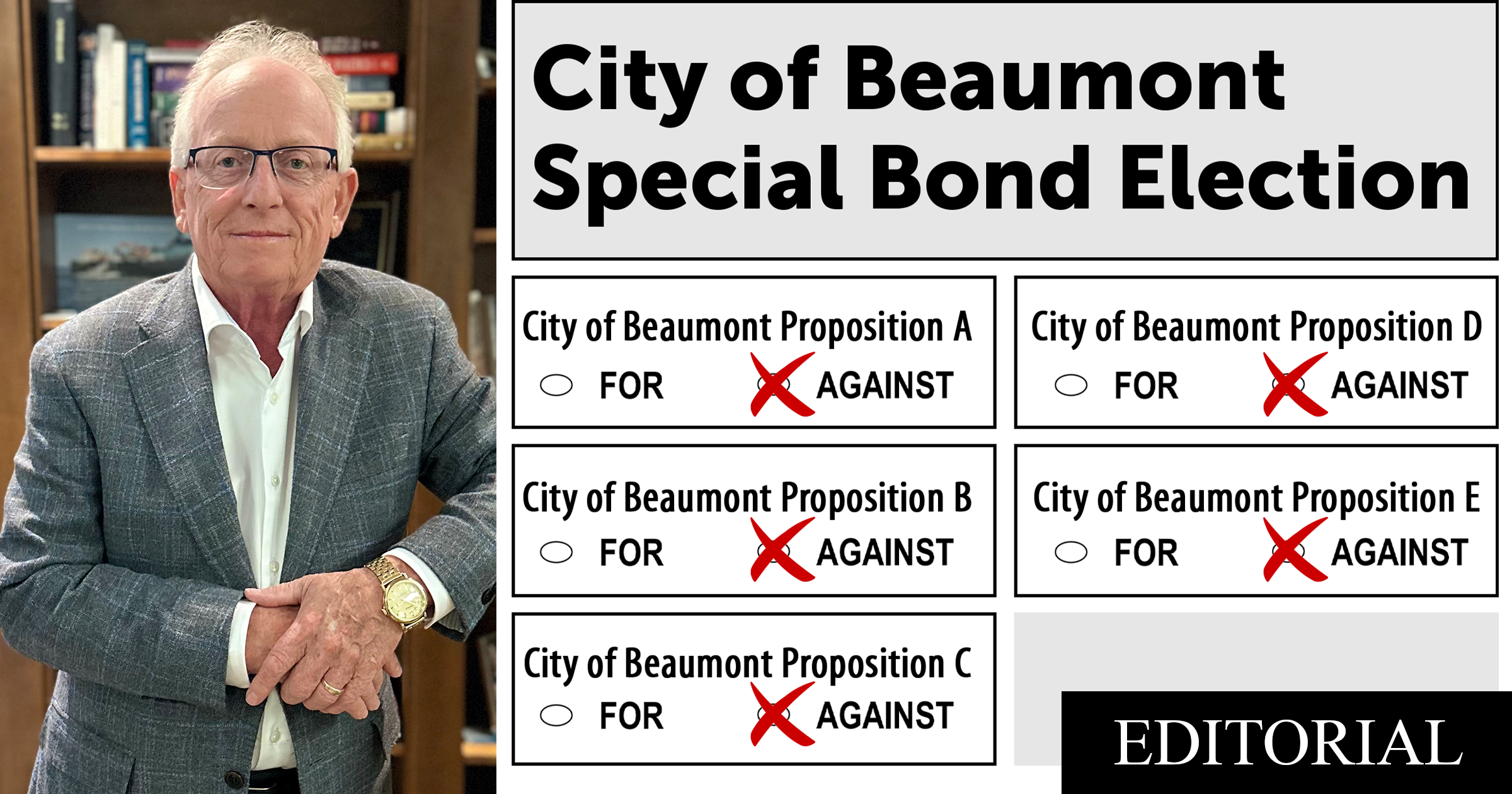
Beaumont voters are once again being asked to open their wallets — this time for a $264.1 million city bond package on the November ballot that will cost roughly double that when factoring in bond debt as recited on the actual ballot. Supporters call it visionary. But, when looking closer, the ploy to get voters to raise their own taxes feels more like political theater than strategic investment.
Start with the math. The city projects an average tax increase of about $14.25 per month for a $150,000 home if all five propositions pass. What the city doesn’t emphasize is that repayment can stretch for decades – and home values (and taxes) rise annually with no city intervention of not collecting more and more taxes from each and every property owner every single year. And, while city officials loosely talk about a 20-year term, a legal notice from the city states the bond could be financed for up to 40 years. At a modest 5% interest over the payoff period, taxpayers could end up repaying more than $600 million — more than double the original amount.
One of the smallest items in the package — about $1 million for downtown “real-time crime center cameras and technology improvements” — illustrates the problem. If history is any indication, the equipment will likely be obsolete in three to five years, but taxpayers could be paying for it over 30 or 40 years — with interest. The true cost would be about $2.2 million for equipment that won’t last a decade. That’s not smart investment; it’s deferred debt disguised as progress.
A new animal-care facility has been touted as one of the most popular projects. But, what’s missing from city “marketing” materials is that new animal care construction won’t expand capacity — it simply modernizes the existing building footprint. While the cosmetic fix makes for a prettier façade, it is not a functional development that will allow the city to care for more animals like staff indicate is needed. Voters deserve to know exactly what they’re paying for — and it isn’t an expanded animal shelter.
Then there’s how the bond itself was built. The Beaumont Bond Advisory Committee initially recommended about $210 million in projects. The total bond to be presented to taxpayers ballooned to $264 million after council members added their own priorities and pet projects. Grouping projects under singular propositions allows for money to flow freely between the largest proposed projects, none of which are given any real specificity, fluctuating from estimates that allegedly round to the nearest dollar and others that round to the nearest million dollar.
Beaumont’s recent history with public debt gives reason for skepticism. Beaumont city leadership is quick to parrot the notion that “Beaumont hasn’t had a bond in 43 years,” but fail to acknowledge that the citizens of Beaumont are still paying for the 2007 Beaumont ISD $388.6 million bond debacle. The whole process left taxpayers with a bitter taste after funds were mismanaged, mishandled, and misappropriated, and its CFO and comptroller were convicted for misdirecting millions of dollars to their own private accounts. An electrical contractor privy to high-dollar payouts is still appealing convictions related to theft from BISD a decade later. Residents haven’t forgotten — and shouldn’t.
And credibility? Almost nonexistent. The city appointed a Bond Advisory Committee that included former Mayor David Moore, convicted in 2003 of bribery and money laundering tied to the city’s small-business loan fund. He served 16 months in federal prison. The councilmember who nominated him was named in that same trial as the alleged bag man delivering bribes. That alone should have disqualified both from advising on hundreds of millions in new debt.
Meanwhile, the city faces far more urgent challenges. Beaumont’s violent-crime rate stands at 1,376 per 100,000 residents — nearly four times the national average. One in five Beaumont residents live below the poverty line, which is exceptionally well below a living wage line that thousands more residents can’t meet, per Census Bureau data. Potholes swallow tires. Tap water is brown. Drainage systems collapse under routine rain. Neighborhood ditches clog for weeks.
Yet, the bond treats infrastructure as just another category alongside recreation centers, sports facilities, and youth centers — a laundry list designed to attract votes, not solve problems. Needs and wants are given the same fervor. Yes, there’s $20 million for streets and $28.1 million for drainage. But infrastructure amounts are dwarfed by the total and scattered among less critical amenities, so you won’t get a new police department unless you want to pay for pork. This is not a plan based on priorities; it’s a sales pitch. The message to voters is clear: There’s something for everyone, so please vote yes. That’s marketing, not leadership.
The bigger question is trust. Who will ensure the money is spent responsibly? City Manager Kenneth Williams has staked his brief tenure on this bond, but many question whether Beaumont is a long-term commitment for him. Routine raises in the city manager’s already inflated pay, along with five-figure “bonuses” for an administrator that consistently budgets expenditures in excess of revenues, may keep him a little longer — but who knows what to expect from a professional “retiring” from his last city manager job freshly after signing a new contract. Mayor Roy West, while fervent in his claims of “having the power” to exact efforts like a premature bond “oversight” committee with no oversight authority, has not shown the fiscal discipline this scale of borrowing demands. His rah-rah attitude of spending money to make money fails to acknowledge that the money he wants to spend is coming from already overburdened taxpayers for the benefit of businesses like the one he owns. The city doesn’t need cheerleaders — it needs watchdogs.
As for the mayor forming an oversight committee before the vote, adding the names of persons respected in the community is another marketing ploy also utilized with the 2007 BISD bond. Bond committees are touted as ingrained watchdogs but, like with the BISD bond committee and even with the city’s own initial bond committee, members can spend their days and nights making recommendations, but the city has no obligation to adhere to them. Even with BISD’s citizen bond committee in place, millions of dollars were pilfered, and the reputation of that oversight committee was tarnished even though they really had no power to prevent the tragedy from ever taking place.
Voting against this bond isn’t voting against progress. It’s a vote for integrity, for fixing what’s broken before signing a decades-long IOU. Beaumont’s future depends on honest priorities, real oversight, and leadership willing to say no to distractions. Until we have that, taxpayers should do the same. Vote no.
.