

Beaumont City Council’s decision to not demolish the fire-ravaged Gilbert Building in the center of downtown has resulted in continued closure of the surrounding streets – much to the dismay of motorists rerouted through a maze of twists and turns to navigate the public pathway, as well as business owners claiming the shuttered streets are causing an economic hardship that is becoming increasingly overwhelming to overcome.
Discussed during an hours-long session of the Aug. 20 Beaumont City Council meeting, city staff working to secure the downtown area had recommended razing, or demolishing, the Gilbert Building. The vacant 100-year-old building, heavily damaged by fire in June, was on the chopping block due to the continued state of deterioration that poses a stated safety risk to the community. Additionally, as pointed out by city staff and community members taking to the podium to be heard, the protective barricades preventing foot and vehicle traffic along the mostly commercial district where the burned building still stands have impacted business and quality of life access – and cost the city upwards of $12,000 to maintain, so far.
City Manager Kenneth Williams, city spokesperson Tracy Kennick advised, has ordered a meeting “ASAP,” (as soon as possible), for administration to meet with pertinent parties to work towards opening the streets.
“For now, they stay up,” Kennick said of the barricades, although city leadership hopes to know by the beginning of the week of Aug. 26 when the barriers can be removed.
Burning bridges
Just after 7 p.m. June 6, the Beaumont Fire Department responded to 328 Bowie St. to find the historic and longtime unoccupied downtown Gilbert Building ablaze.
According to Beaumont Fire Chief Earl White, nearby, dozens of homes and businesses were evacuated until the flames could be controlled and the area secured. By 6:30 a.m. the following morning, the last firefighter left the scene, but crews continued ongoing monitoring.
By June 17, several adjacent streets had been barricaded because, White said, there was an immediate concern for the safety of the burned structure, and that the Beaumont Fire Department would be working directly with the building’s owner, identified as Tom Flanagan, to determine a course of action.
“We were concerned about the safety of the Gilbert Building before the fire and we are increasingly concerned about the integrity of the structure now,” White said in the wake of the blaze. As evidenced in written communication with building owner Flanagan, the Gilbert Building was deemed unsafe and listed as an imminent danger in March – three months before the fire. “We were going through all of the downtown buildings before the fire, making inspections and planning to work with owners.”
Beaumont data released in the aftermath of the fire also revealed that the Gilbert Building was cited during an inspection in April, and owner Flanagan assured the city that repairs would begin within 30 days. When the deadline for repairs came and went in mid-May, the city was forced to move forward with the process of hiring a contractor to secure the building – at the expense of the city; the intent, as reported by the city, was/is to seek reimbursement from Flanagan.
“This catastrophic event serves as a wake-up call – a poignant reminder that, unless stringent enforcement of ordinances and codes is implemented, we risk further irreparable losses to our once vibrant downtown,” said Tom Bell with Beaumont Main Street, a national Main Street city and Texas Main Street Program. He added that the Gilbert Building situation is a stark reminder of the consequences of neglect. Ultimately, Bell held the city responsible: “We demand accountability from our city government.”
City officials, passing the baton of accountability to Flanagan, then gave the offending business owner 60 days to basically convince staff as to why the city should continue to work with him on not demolishing the Gilbert Building. Flanagan was tasked with putting up a fence and producing a printed plan to get the building up to code.
Exactly 60 days later, Assistant City Manager Chris Boone said, Flanagan submitted a plan to begin interior demolition and assess what can be done moving forward by Nov. 1. Planning and Community Development Director Demi Engman, pointing toward the midnighthour production of the Flanagan plan, still recommended demolition of the structure based on the information available to the city workers.
Flanagan’s contracted engineer, Rob Fuselier of Alliance Engineers, advised that the building may be salvageable.
“There’s degrees of stability,” Fuselier said. He added that the building withstood the winds of Hurricane Beryl but fell short of opining as to whether the Gilbert Building would continue to hold its own against nature’s wrath. “We need to get more information with more close inspection of the interior of the building… facilitated by the clearing operation.”
To allow another 60 days for Flanagan to do something – or not – with the Gilbert Building was totally objectionable to small business owners like Meghan Cobb. Should the barricades continue to shut off street access to her shop, Taluka Trades on Pearl Street in downtown Beaumont, Cobb said she will be out of business by the end of the year.
“I was at that store day and night,” Cobb said of starting Taluka Trades in March. “We got a lot of foot traffic.”
When the Gilbert Building adjacent to Taluka Trades caught fire in June, and the barricades went up, foot traffic dropped to nothing.
“People love the store but it’s an access thing. Funny how the streets being shut down coincides with the diminishing business,” Cobb shared of her income/loss reports, which divebombed from totaling sales of several hundred dollars a day. “When the traffic receded, and the numbers plummeted … most of my days are now zero-dollar days.”
According to Flanagan’s assessment, complainants like Cobb “may be overreacting.” Afterall, Flanagan said, everyone patronizing businesses on downtown streets – closed though they may be – are taking advantage of free parking in his lots.
“Any parking that I use I have to pay for,” he added.
Hurt and feeling like he’s “on trial,” Flanagan said, he’s actually the victim in this situation.
“We feel badly that any business is hurt,” he said. “It hurts me when that happens.
But, he added, “We were the victim. We had nothing to do with this fire, (and) “since the fire, we’ve had 15 different cases of violent intrusion” on Flanaganowned vacant properties.
“People have a short memory and years go by fast,” Flanagan said of his prior work in downtown Beaumont. “As a matter of getting things done, I have a track record.”
Questioning Flanagan’s track record with the Gilbert Building, the council asked how long Flanagan owned the Gilbert Building before the fire.
“The city didn’t want to do anything with it,” Flanagan said, deflecting the direct question momentarily. “We were buying buildings no one else wanted.
“We fought for 20(ish) years – at each other’s throats – so no progress was made.”
Flanagan ended with the estimation that he’s owned the Gilbert Building for approximately 18 years now. However, if given just a few more months, Flanagan said he may finally repair the property as required by city code.
“As quickly and safely as possible,” Flanagan said, the plan is to move forward to save the building – maybe.
“We’ll have everything complete by January,” Flanagan proposed.
Fire makes block ‘hot’
Flanagan’s fire was contained to the vicinity of the downtown corridor where the building still sits in a state of disrepair and arguable stability – but, as evidenced from the newly proposed ordinance aimed at owners of vacant structures throughout the city, the fallout from the failed negotiation to be a good commercial neighbor “just because” has resulted in staff seeking stricter control over all owners of vacant buildings.
According to the proposed order, “There is a presumption of vacancy if all lawful uses in the buildings or structures have ceased or reasonably appear to have ceased for more than sixty (60) days from the date this ordinance is adopted.”
Keeping with the standard “60 days to comply” rhetoric, “Existing vacant structures, as defined herein, shall be required to register within sixty (60) days of the date this ordinance is adopted.”
Originally on the agenda for adoption at the Aug. 20 city council meeting, the ordinance regarding vacant buildings was set aside until another day. As proposed at the request of Mayor Roy West, the matter will be visited at an upcoming city meeting.
At the conclusion of the Aug. 20 discussion to allow Flanagan more time, 150 days, to complete repairs to the Gilbert Building, Engman outlined conditions of agreement with the city, although “staff does still recommend demolition,” she added.
According to Engman, Flanagan must meet requirements such as: • Restoring the roof, walls and exterior to original structural capacity by Jan. 10, 2025;
• Reporting progress in intervals, obtaining applicable permits and maintaining structure to city code; and
• Paying for the city’s costs associated with barricades that have been utilized since the fire to detour traffic throughout downtown, a cost of roughly $12,320 for 34 waterwall barricades.
“The traditional work programs are given the same 150 days,” city attorney Sharae Reed said. “It’s consistent with our current practice.”
While the city administration and staff await word as to whether the barricades can come down even though the walls of the Gilbert Building are not, Cobb and other small business owners are left on their own to figure out access in the interim.
Should the roads stay closed, Cobb said, “I won’t make it. I’m already getting into serious debt.”
“I don’t want to be adversarial with Mr. Flanagan,” Cobb added, further stating her love for Beaumont, especially downtown Beaumont, where her artwork in the form of murals adorn the exterior walls of a many beloved landmarks. “I just want my business back.”
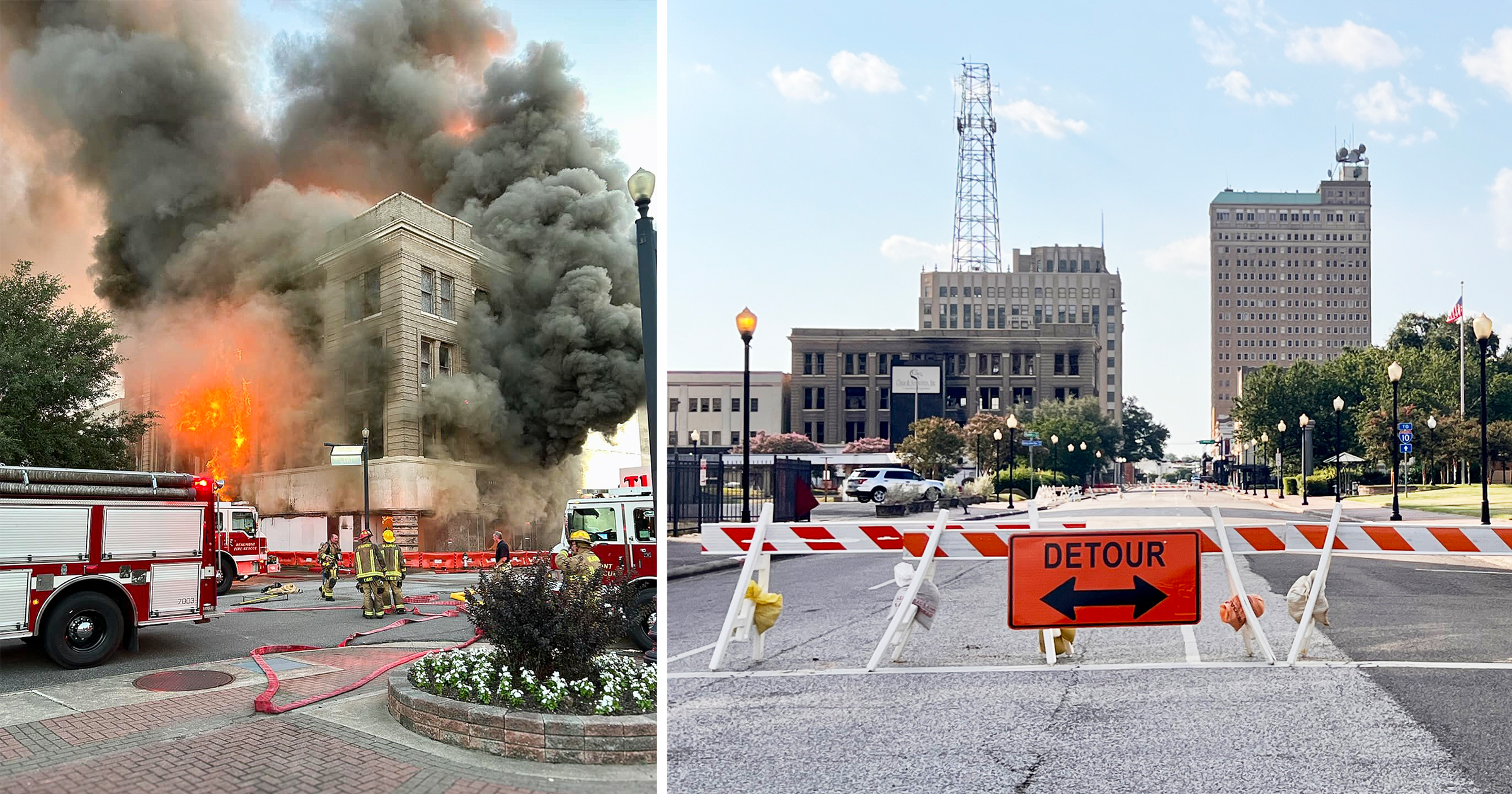
Downtown Beaumont streets remain closed as the Gilbert Building owner asks for more time to make repairs.